




Kronehoefstraat 85
5612 HL Eindhoven
BTW NL863902509B01
Intelligent business process automation: what it is and what it delivers
qw
vc
mshm
.svg)



Intelligent business process automation pairs fixed workflow rules with an AI agent that judges and handles the exceptions to those rules itself. Where classic automation stops the moment a case deviates from the standard path, the agent takes over that decision within boundaries agreed in advance. The result: the part of the process that used to always land on someone's desk now mostly keeps moving on its own.
Business process automation has been around for years. Macros, workflow tools, and Robotic Process Automation (RPA) carry out fixed steps: pull data, fill in a form, send a confirmation. As long as a case fits the script, that works fast and error-free.
Intelligent business process automation adds a layer on top: an AI agent that doesn’t just execute steps, but also judges which step makes sense once a case deviates. That’s the difference between following a process and understanding one.
We wrote earlier about business process automation with AI agents as the rule-based layer itself: which steps you define and how you set them up. This article is about the intelligent layer on top of that, not a replacement for that groundwork.
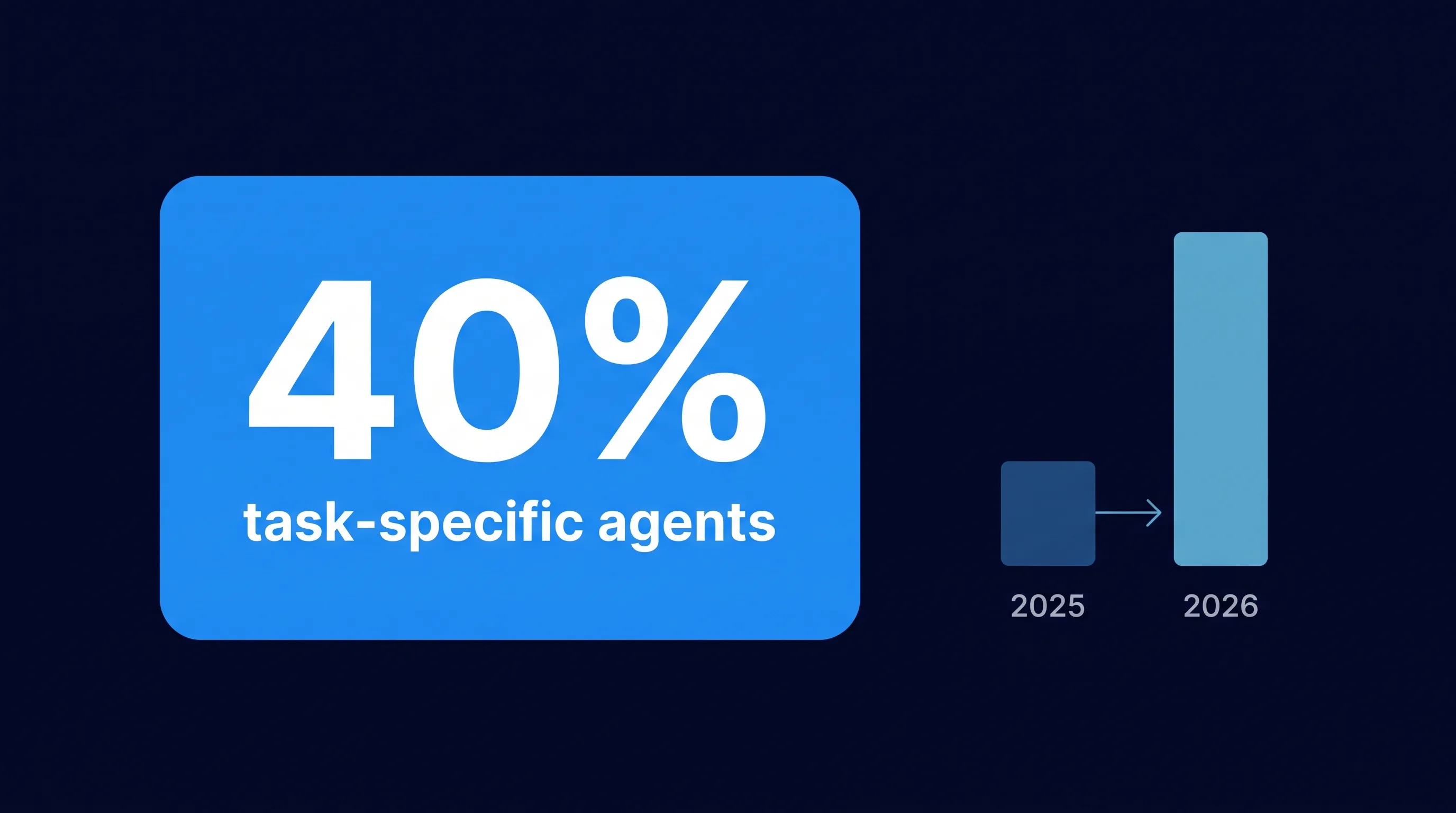
How much room that layer gets varies sharply by company. Only 15% of Dutch SMEs use AI to automate routine tasks (Rijksoverheid, 2025), while analysts predict that forty percent of business applications will feature a task-specific AI agent by 2026, up from under five percent in 2025 (UC Today, 2025). That gap is exactly where the upside for SMEs sits.
The line doesn’t sit at the tool, it sits at the decision point. A workflow tool executes a step the moment a condition is met. The moment that condition isn’t clear, it stops and waits for a person. What the literature calls agentic AI is exactly that: taking over that decision point within boundaries agreed in advance, not the execution afterwards.
We worked out this distinction earlier in RPA vs intelligent automation: what’s the real difference? Here, you put it side by side per situation.

Don’t assume too fast here: fewer than 15% of companies with an automation package have actually switched on the agentic features, even though they’ve been able to for a while (Forrester, 2025). The technology is there; careful rollout is the part that takes time.
Exceptions are the part of a process that doesn’t follow the script, and exception handling is exactly the discipline that deals with them. They look small because they’re a minority of cases. In practice, they often cost the most time, because every deviating case has to be handled by hand all over again.
Say an order-processing process at a trading company is largely automated: an incoming order is recognised, entered, and confirmed without manual intervention. Say further that part of those orders deviates: a wrong item number, a delivery time that doesn’t match stock, a customer ordering outside the standard terms. In a purely rule-based setup, that part falls back on an employee, and that part is exactly what decides how much time the whole process still saves on balance.
This is an illustrative scenario, not a real client case: it shows why the payoff of automation doesn’t sit in the standard path, but in what you do with what deviates from it.
There’s a second reason exceptions are so persistent: they’re often the cases still being resolved by email or chat today. Someone types out the situation, someone else assesses it and types the answer back. That’s useful, but it stays a chat-shaped fix: a person re-explaining, case by case, what needs to happen. An agent that recognises that same category of deviation is the step from that conversation to work that just keeps moving on its own.
An agent adds nothing to the steps that already run fine. It adds a judgment call at the moment one of those steps no longer holds: does this order fit a known pattern, has this type of deviation been handled well before, does this case still need to go to a person.
That makes an agent not a separate tool bolted on top, but a layer above your existing processes and systems. Inside an AI business brain, that layer works across multiple processes, with the same agreements about when it may decide on its own and when it may not.
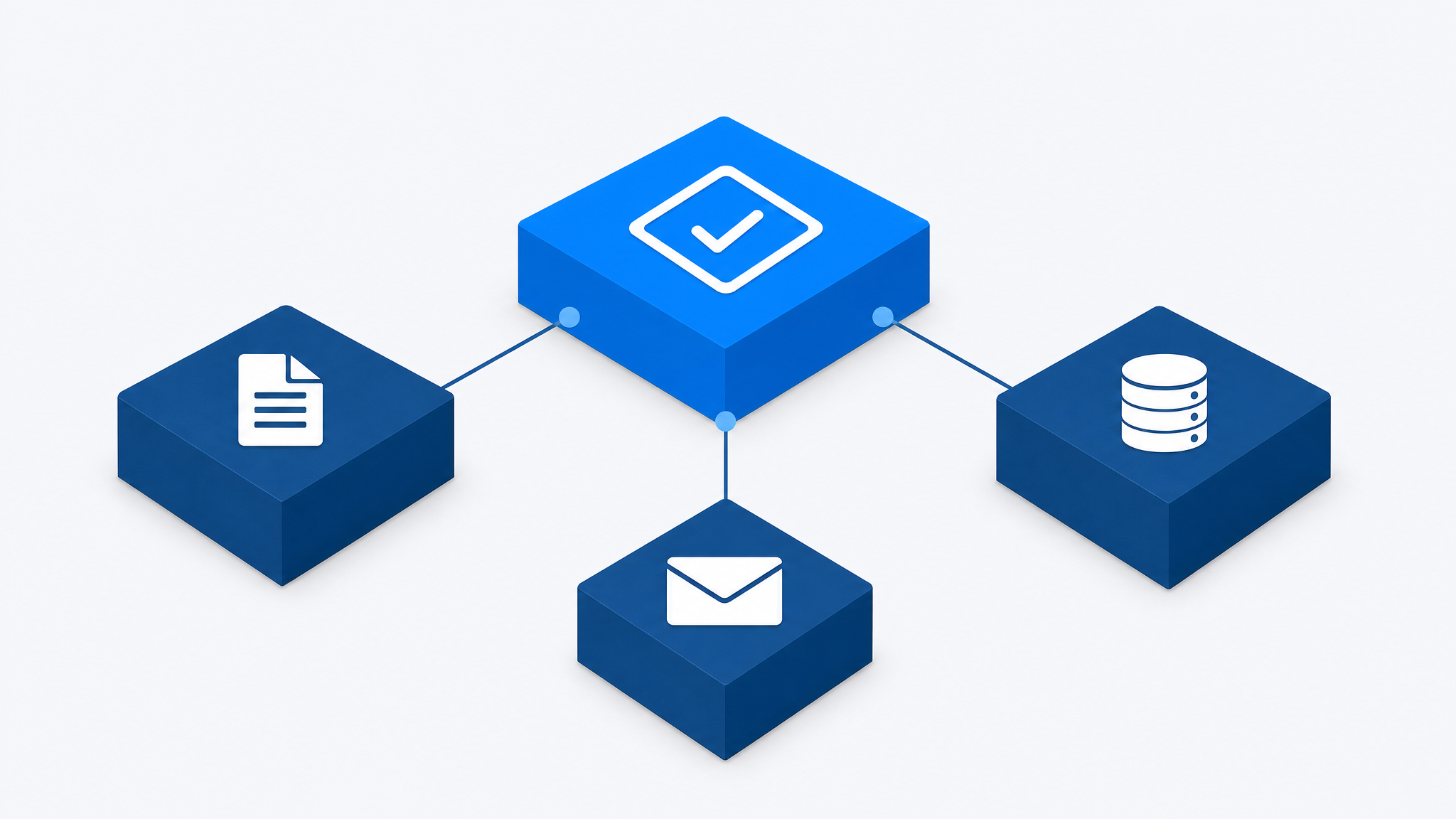
Concretely, that means three things: the agent gets access to the systems where the order, invoice, or request already lives, a brief that spells out exactly what counts as good enough to handle on its own, and a boundary within which it may do that without asking. Without those three, it isn’t an agent, it’s a complicated chatbot. Our AI Agents & Process Automation approach always starts by defining those boundaries, before anything decides automatically.
An agent that decides on its own has to be something you can check. Organisations running AI agents report an average of 54 agent incidents per year that need a human correction, 17% of them serious enough to cause hours of downtime (IBM, 2026). That’s not an argument against agents, it’s an argument for building the controls in advance.
Four things belong here: evals that test in advance how the agent responds to known and unknown cases, human-in-the-loop moments at the points where a mistake is expensive, explicit error handling for when the agent doesn’t know something, and logging that lets you see afterwards why a decision turned out the way it did.
Human-in-the-loop is more than an approval button. Research on AI governance shows a human check only helps if the reviewer genuinely has the room and the mandate to overturn a decision, not as a formality that shifts responsibility from the builder to the approver (IBM, 2026). A good agent makes control easier, not unnecessary.
Don’t start with the process that has the most exceptions, and not with the one that has none either. A process without deviations doesn’t need an agent, and a process full of chaos needs cleaning up first before an agent can add anything.
Pick a process that already runs largely rule-based today, with a recognisable, recurring category of exceptions: a fixed type of deviation that an employee resolves roughly the same way every time. That pattern is exactly what an agent can learn to recognise and take over, within boundaries you set in advance.
We worked this out step by step in Intelligent process automation for SMEs: the three-layer model explained, with the model we also use with clients to decide where the first layer starts.
Don’t expect a miracle cure from that first process. The agent solves one category of deviations, not every conceivable problem, and the first few weeks go into evaluating and adjusting before the time savings become visible. Plan for that up front and you won’t be caught off guard.
Regular business process automation executes fixed steps and stops the moment a case deviates from the script. Intelligent business process automation adds an AI agent that judges that deviation itself and, within agreed boundaries, chooses a next step. So the difference isn't in the execution, it's in who makes the decision when there's an exception.
No. RPA executes fixed, rule-based steps and works great for structured, repeatable tasks. Intelligent process automation builds an AI agent on top of that, which judges the exceptions to those rules. The two don't replace each other, the intelligent layer sits on top of the rule-based layer.
Processes that already run largely rule-based today and have a recognisable, recurring category of exceptions make the best starting point. A process without deviations doesn't need an agent, and a process full of chaos needs cleaning up first. Look for the type of deviation an employee resolves roughly the same way every time.
No, an agent takes over part of the assessment, not the responsibility. Human-in-the-loop stays necessary at the points where a mistake is expensive, and someone still has to keep evaluating and adjusting the agent. The payoff is less manual work on recurring exceptions, not fewer people on the process itself.
By testing in advance how the agent responds to known and unknown cases (evals), by building in error handling for what the agent doesn't know, and by logging every decision so you can ask why afterwards. Human-in-the-loop on the most expensive decisions stays the last safety net.
Start with a process that has a clear, recurring category of exceptions, not the process with the most chaos. Define in advance what the agent may handle itself and when it must hand off to a person. Only then build out to other processes.
An agent that recognises and handles exceptions itself isn't a separate tool, it's a layer above your existing processes. We build and manage that layer, from the first process to a full rollout.
See AI Agents & Process Automation


.svg)