



Kronehoefstraat 85
5612 HL Eindhoven
BTW NL863902509B01
System integration consulting: when you need it (and when you don't)
qw
vc
mshm
.svg)



You need system integration consulting once 3 or more systems have to work together and you notice staff re-typing data or reports no longer matching. With 2 systems and an available standard connector, a simple connection is enough, and consulting is unnecessary overhead.
System integration consulting and "just get an integration built" sound like the same thing, but they are two different services. An integration is a technical project: two systems talking to each other through an API or a connector. Consulting is broader. It starts with an inventory of your entire system landscape: which systems you have, where the data lives, and which process breaks if you change something.
In a workflow automation project you don't look at one connection, you look at how information flows through the whole organization. That difference is exactly why companies get stuck: they ask for one connection, while the problem sits in five systems at once.
An integration platform (IBM, 2025) connects multiple applications, systems and data sources so they function as one whole, instead of separate islands someone has to bring together by hand. Consulting is the thinking that happens beforehand, not the connection itself.
Internally we call that a connected AI business brain: every system connected into one whole that an AI agent or an employee can trust to hold accurate data. Without that foundation, every AI tool sitting on top of separate systems is a patch on a leak you can't see.
So the distinction is easy to test: is this one connection between two known systems, or a landscape of five or more systems that nobody fully understands anymore? The first is a connector job. The second is a consulting question.
Three signals come up in almost every conversation. The first: people re-type the same data into two or three systems because there is no connection. A quote in the CRM gets manually copied into the accounting software. An hour of work a day, per employee, is not the exception.
The second signal: reports stop matching. The ERP says one thing, the CRM says another, and nobody knows anymore which number is correct. That isn't a reporting bug, it's a sign the data sources have drifted out of sync.
The third signal is growth that stalls on system limits: a new location, a new product, or a new customer needs a process the current system landscape simply can't handle without manual work.
This pattern isn't unique to SMEs. The MuleSoft Connectivity Benchmark Report 2025 (Salesforce, 2025), based on 1,050 interviewed IT leaders worldwide, found that the average organization manages 897 applications, of which only 29% are connected. Even large organizations with an IT department leave most of their systems running in isolation.
For an SME with 5 to 10 systems, the ratio is often worse: nothing is connected by default, and any connection that exists was built by an employee who figured it out with a free tool.
The same research reports that 83% of respondents see integration delays as lost revenue (Salesforce, 2025). That is exactly the signal that makes an integration partner worth investigating: not the annoyance of re-typing, but the revenue left on the table because a process is too slow.
A fourth signal tends to show up later: new hires can't be onboarded quickly, because every process is a chain of manual steps that only lives in one employee's head. The moment that person is on vacation or leaves, part of the process grinds to a halt.
Recognize two of these three or four signals, and that is no longer a coincidence. It means your system landscape has outgrown the loose connections you currently have, and a structured approach pays off faster than adding one more connector.
Not every connection problem is a consulting engagement. If you want to link two systems with a standard connector, such as Zapier or a native integration the software vendor already offers, a heavy engagement is overkill. That's a matter of configuration, not architecture.
The rule of thumb: with 2 systems and a standard connector that already supports the data you need, you can handle it yourself or with a freelancer in days, not weeks. Consulting adds no value there, only cost.
Dutch SMEs are digitizing faster than often assumed: the share of SMEs that reached a basic level of digitization rose from 75% in 2021 to 81.5% in 2024 (Dutch government, 2025). Being digitally active is no longer the differentiator. What matters is how many of those systems actually talk to each other.
A simple connection stays simple as long as there are no exceptions, no duplicate data sources, and no dependencies between more than two systems. The moment any one of those three applies, it's no longer a simple connection.
The Dutch national statistics office CBS (CBS, 2025) tracks annually how Dutch companies use cloud, automation and systems. Those figures show digitization is widespread, but say nothing about how well those systems are actually connected. That is exactly the gap system integration consulting fills.
A system integration consulting engagement starts with an inventory: which systems exist, where the data lives, and who owns which process. Without that overview you build a connection on an assumption, and that assumption rarely survives the second or third system.
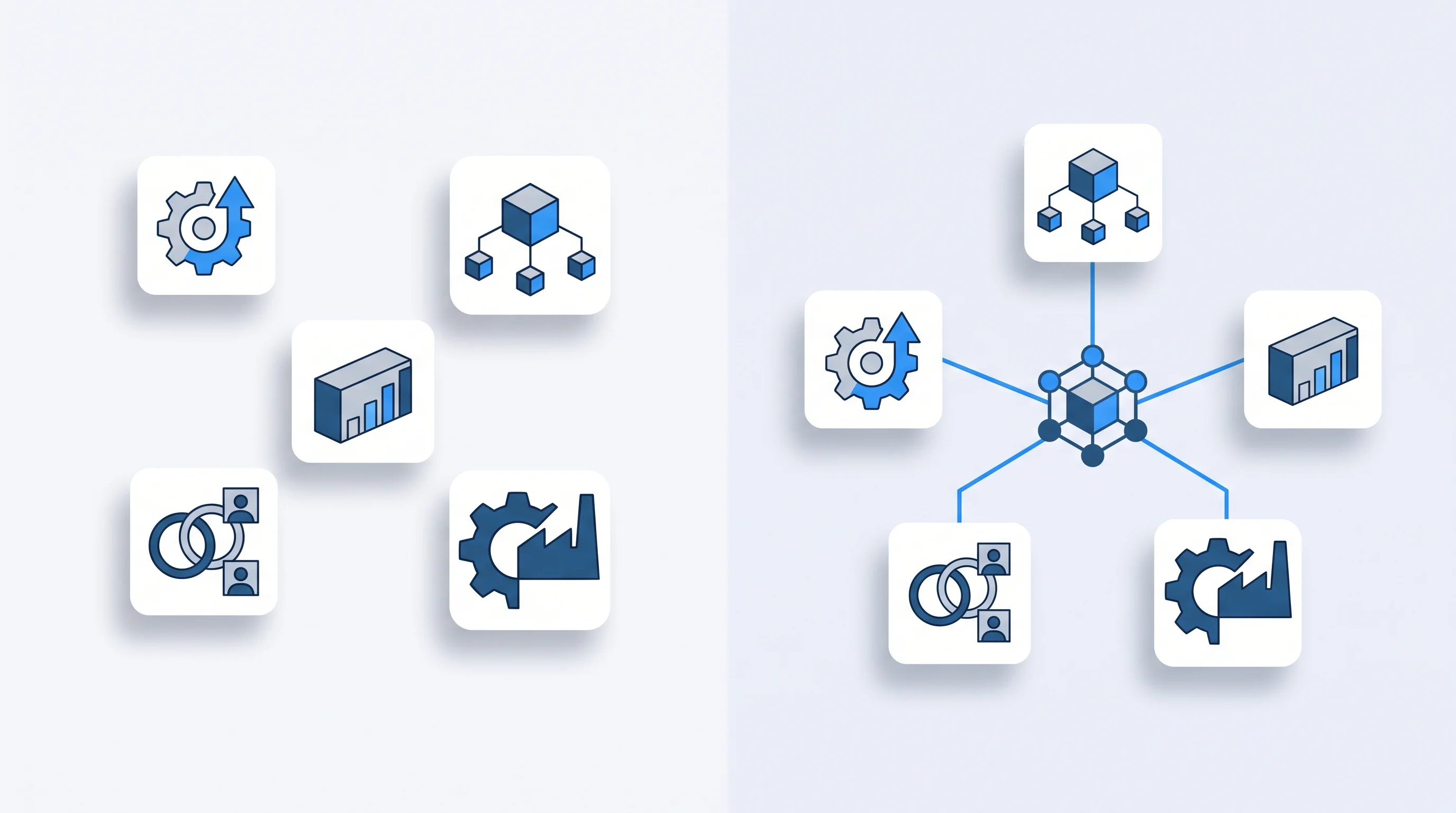
Next comes an architecture choice: connect systems one-to-one (point-to-point), or through a middle layer that connects every system in one place (an integration platform, also called iPaaS)? Point-to-point is faster to build with two systems, but with four or more systems it turns into a tangle of direct connections nobody can oversee anymore.
A middle layer takes more time to set up, but keeps things manageable at five, ten or twenty systems. Our SaaS and ERP integration approach always starts by making that choice explicit, instead of defaulting to point-to-point because it looks fastest today.

After the architecture choice comes implementation: building the connections, testing edge cases, and setting up a form of event-driven automation so a change in one system automatically triggers the right outcome in another, without anyone pressing a button.
The last step is safeguarding: who owns the connection when something breaks, where is the documentation, and who monitors whether the data connection keeps working. A connection without an owner becomes, within a year, a connection nobody dares touch anymore.
These four steps, inventory, architecture choice, implementation and safeguarding, don't always run one after another in practice. At an organization with a lot of custom software, the inventory sometimes takes longer than the implementation itself, simply because nobody knows exactly which fields come from where anymore.
What does make an engagement predictable is that every step has a concrete deliverable. After the inventory, there's an overview of systems and data flows. After the architecture choice, there's a decision backed by reasoning, not an assumption. After implementation, the connection demonstrably works on the edge cases, not just the happy path.
"Just get a quick connection built" is often the more expensive route, you just see the bill later. A connection built without an architecture choice breaks the moment one of the two systems gets an update or a field name changes.
Three problems come up over and over. There's no documentation, so the next developer starts blind. There's no exception handling, so an exception in the data lets the connection fail silently. And there's no owner, so nobody notices until a report stops matching.
That pattern is called technical debt: every quick connection that saves time today costs more time later to fix than it ever delivered. A connection without documentation isn't time saved, it's delay postponed.
When choosing an integration partner, one question helps more than ten others: does the partner build systems themselves, or only advise? We build the way we advise, which means an architecture choice we propose is also a choice we have to maintain ourselves.
Not sure whether you need a broader roadmap before starting on integration, for example because you don't yet know which processes take priority? Then an AI strategy and roadmap is often the logical step before integration, not after.
Also ask every quote what happens after delivery. A partner that stops the moment the connection works technically leaves you without documentation and without a plan for what changes when one of the systems gets a major update. A partner that includes safeguarding by default often costs a bit more upfront, but saves the repair work that otherwise follows within a year.
The choice between a simple connection and a consulting engagement depends on the number of systems, the complexity of the data, and how much it costs you if it goes wrong. Below is the core of that decision framework.
A practical step plan, no empty promises: start with an inventory of your systems and the data moving between them. Then deliberately choose between point-to-point and a middle layer, instead of defaulting to the fastest option. Build one connection first as a proof of concept, and only expand once it demonstrably works. Set up documentation and ownership before you build the next connection, not after.
Every step in this plan is meant to make the next connection cheaper, not more expensive. That's the difference between a system that grows with you and a pile of connections someone eventually has to untangle.

That depends on the number of systems and the chosen architecture. A single connection with a standard connector costs a fraction of a consulting engagement that maps and safeguards an entire system landscape. Always ask for an estimate based on your own systems, generic prices say little.
Getting an integration built is usually one direct connection between two systems (point-to-point). An integration platform (iPaaS) is a middle layer that connects multiple systems at once, so with five or more systems you're not left managing ten separate connections.
A simple connection with a standard connector is often done within days to weeks. A consulting engagement with inventory, architecture choice and safeguarding takes weeks to months, depending on the number of systems and whether documentation already exists.
If both systems have a native integration or a supported standard connector and your data has no exceptions, you can handle that yourself. Once a third system joins in or the data isn't consistent, you quickly hit limits a consultant spots faster.
Reports that no longer match, staff losing time to re-typing, and connections that fail without any notice. Over the long run this builds technical debt: every quick connection built today costs more time later than it ever saved.
With two systems, an available standard connector, and no exceptions in the data, an integration partner is overkill. Handle it yourself or with a freelancer, and save the consulting question for when a third or fourth system joins the mix.
Systems with a modern, documented API and a native connector are usually quick to connect. Older or custom-built systems without an API, or systems the vendor doesn't support connecting, are the hardest and more often need a consulting approach.
If you can explain which systems you have, where the data comes from, and who owns each process, you're integration-ready. If you can't answer those questions, an inventory is the first step, before a single connection gets built.
Getting your systems to talk to each other isn't a goal in itself, it's a way to save time and reduce errors. We look together at whether an integration partner is the right step now, and what that actually delivers.
See Business Apps & Integrations


.svg)