




Kronehoefstraat 85
5612 HL Eindhoven
BTW NL863902509B01
The Forward Deployed AI Engineer: the role that takes AI pilots to production
qw
vc
mshm
.svg)




Getting an AI pilot to production takes more than a prototype that works well. It takes a Forward Deployed AI Engineer: someone who combines business process, systems, and AI implementation so a pilot turns into a robust, repeatable system for the entire organization.
Many SME directors recognize this feeling. They or their team use ChatGPT or Claude for reports, emails, and analysis, saving 20 to 30 percent of time on individual tasks.
That is not a small result. It is also not a destination. The gain stays stuck in the heads and laptops of a few people, not in the process itself.
Dutch companies are adopting AI fast. Among SMEs with 10 to 249 employees, 29.8 percent used AI in 2025, roughly double the figure from two years earlier (CBS, 2025).
That growth sits mostly in individual use: marketing, sales, and administrative tasks. Few companies have woven AI into their core processes yet. That is exactly the ceiling directors run into: a pleasant result, but no system.
That ceiling costs more than it looks like. As long as AI use stays with a handful of people, the rest of the team does not grow with it. The organization stays dependent on whoever happens to be around that day, instead of a process that delivers the same result every time.
Directors feel that difference most sharply during growth. More customers or more volume normally means hiring more people. An AI agent that runs structurally solves that. A loose bit of ChatGPT use by a single employee does not.

A pilot proves a task is technically feasible. A proof of concept shows the model produces the right output, in a controlled environment, with a limited group of users.
A pilot does not prove the process keeps working reliably outside that controlled environment. Error handling, shifting data quality, and the behavior of colleagues who did not choose the tool themselves stay invisible as long as the pilot stays small.
That gap is why so many pilots stall. Research from MIT’s NANDA initiative shows that 95 percent of generative AI pilots at companies deliver no measurable financial impact (Fortune, 2025).
A pilot that works is not yet a system that keeps working. That is the gap the Forward Deployed AI Engineer was invented for.
Most pilots do not stall because the model falls short. They stall because nobody makes the move from a successful test to a process with ownership, monitoring, and a plan for what happens when it goes wrong. That move is not a technical detail, it is the difference between a demo and a working system.
One person who is good with an AI tool is not a scalable system. The moment that person goes on vacation, changes roles, or is simply too busy, the use grinds to a halt.
Loose experiments with no clear line are exactly what an AI roadmap is for: a plan that stops AI use from staying scattered among a few early adopters.
The difference between loose use and a structural system comes down to three things: who manages access, who is responsible when it goes wrong, and whether the process is documented outside one person’s head.
The term originally comes from the software industry, popularized by companies like Palantir. A forward deployed engineer does not work from an IT island, but sits inside the client’s team and builds the solution in the environment where it is actually used (Wikipedia, 2026).
A Forward Deployed AI Engineer applies that same principle to AI. He combines three things: knowledge of the business process, access to the systems that process runs on, and the skill to actually build the AI implementation.
That is different work than using a standalone chat window. Where generative AI answers a question, agentic AI carries out steps independently within a process. A Forward Deployed AI Engineer builds exactly that: systems that take over work, not just offer suggestions.
We call the result digital workers: AI agents that run structurally within the business process, not loose tools a person opens now and then.
In practice, this means a Forward Deployed AI Engineer spends as much time talking to the people who currently run the process as on the technology itself. Without those conversations, he builds a system that is technically sound but that the team does not recognize as an improvement to their own work.
Four things are on a Forward Deployed AI Engineer’s list, in this order.
First he maps the existing process: where the time savings sit now, and where the risk sits if an AI agent takes over a step. Then he connects systems that currently sit apart, so an AI agent works with live data instead of a copy that goes stale fast.
Next he builds in error handling and human-in-the-loop: an AI agent that is uncertain hands the work back to a person instead of guessing. Last, he brings the team along, because a system nobody trusts does not get used.
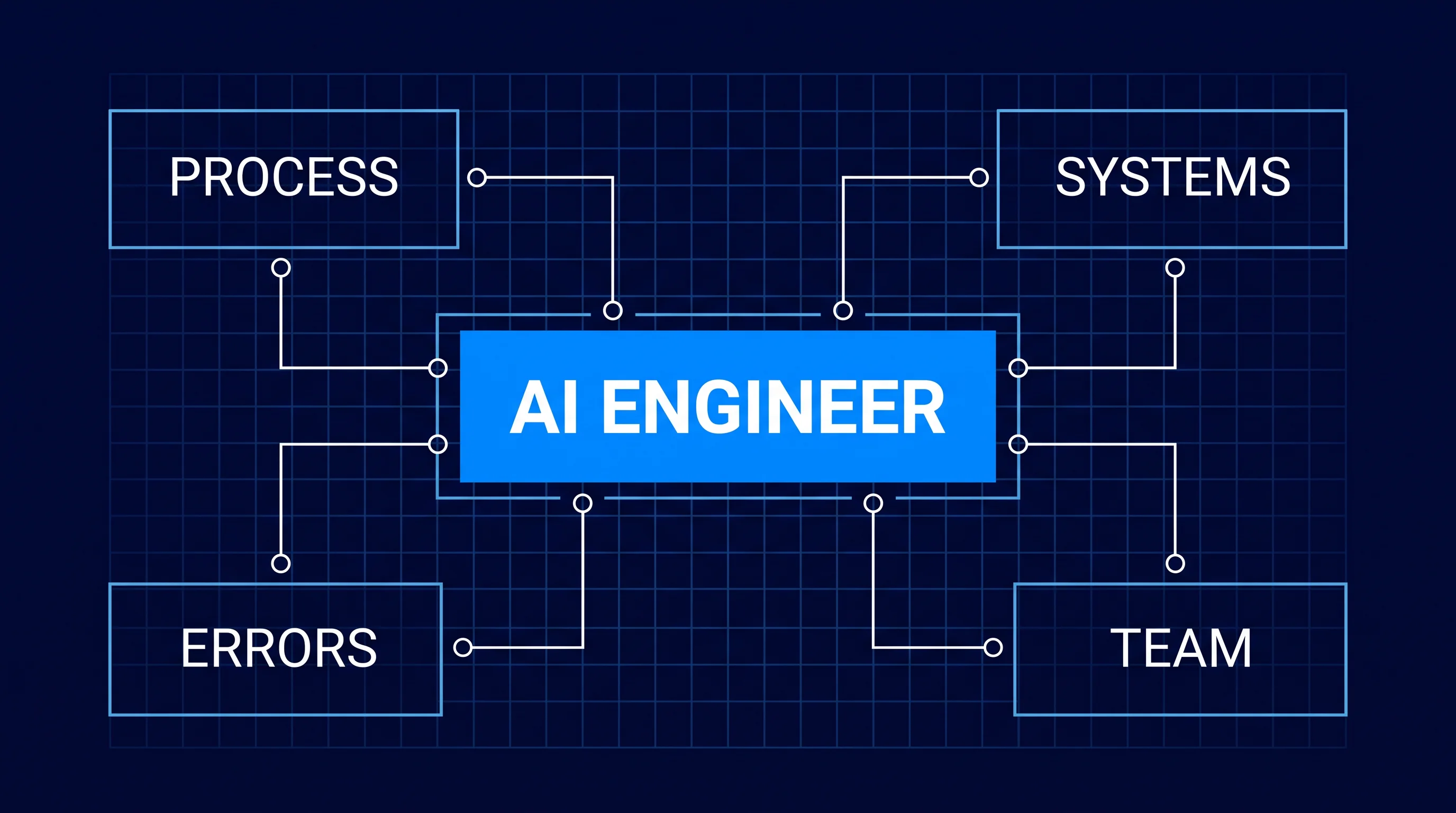
This is no longer a side phenomenon, as the job market shows. The number of job postings for forward deployed engineers grew more than tenfold in 2025 compared to the year before (PostHog, 2025).
The role exists because AI implementation without this link stays isolated.
That order is not random. Connect systems before the process is mapped, and you build a technically elegant solution nobody recognizes. Bring the team in only at the end, and you build a system that works on paper but gets ignored in practice.
The instinctive reaction of many directors is to hand this to IT. That is a mistake.
A Forward Deployed AI Engineer does not decide on servers or software architecture. He decides alongside the process owner: which step can an AI agent do independently, which step stays with a person, and what happens when it goes wrong.
That makes it a business decision, not a technical one. The director stays the owner of the process, the Forward Deployed AI Engineer builds the system around it.
Without that process ownership, AI implementation stays an IT project that promises results the business does not recognize. That is exactly the pattern behind many stalled pilots.
A director who treats this as an IT project waits for a delivery document. A director who treats it as a business role steers what the process should deliver, and checks that weekly instead of only at final delivery. That difference in involvement often decides whether a pilot ends up stuck or keeps growing.
Four questions show whether your organization is hitting this ceiling.
Do several people use AI tools, each their own way, with no agreement? Does the knowledge of what works sit in a few people’s heads, not in a process? Was there a pilot that ran well but was never scaled up? And does nobody know exactly who is responsible when an AI agent makes a mistake?
A government study on AI use among SMEs shows exactly this pattern: entrepreneurs are enthusiastic about their first steps with AI, but hesitate once it comes to structural, organization-wide use (Rijksoverheid, 2025).
Recognize two or more of these questions, and the next step is not trying another tool. It is appointing someone who actually makes the leap from pilot to system.
You do not need a fifth sign to wait. Companies that ignore these signals usually only see the pattern again once the pilot has sat idle for half a year and nobody quite remembers why it was never scaled up.
Most SMEs do not have the budget or need for a full-time AI engineer on payroll. They do not need one either.
A Fractional Chief AI Officer fills the Forward Deployed AI Engineer role on the days your organization needs it: mapping the process, connecting systems, and bringing the team along, without the cost and hiring time of a full-time hire.

We build this way ourselves: first the process, then the connection, then the AI agent that takes it over. That is the same approach we advise our clients to take, and as far as we are concerned the only way to turn a successful pilot into a structurally working system.
Want to talk this through first, no strings attached? You can also just book a quick meeting.
The first step is rarely big. It starts with critically answering the four recognition questions above for yourself, and picking the process where the pilot already exists but was never scaled up. From there, the road to production is short.
A Forward Deployed AI Engineer is someone who combines business process, systems, and AI implementation to actually get AI running in daily work. He does not work from an IT island, but together with the team that runs the process. The goal is an AI agent that works reliably, not just a demo that impresses.
A pilot proves a task is technically feasible, in a controlled environment with a limited group of users. Once the pilot expands, error handling, data quality, and the behavior of colleagues who did not choose the tool themselves come into play. Research from MIT NANDA shows that 95 percent of generative AI pilots deliver no measurable ROI, for exactly that reason.
An IT consultant often advises from the outside and delivers a report or architecture plan. A Forward Deployed AI Engineer works hands-on inside the process itself, connects systems, and builds the AI agent that takes over the work. The difference is in who actually makes it work, not just who advises on it.
If several people already use AI but each in their own way, and a successful pilot was never scaled up, that is a signal. If nobody knows exactly who is responsible when an AI agent makes a mistake, the structure needed to scale is missing.
That depends heavily on the number of processes and systems that need connecting, and varies per company. A Fractional Chief AI Officer makes this manageable by only deploying the days the organization needs, instead of hiring full-time. That keeps the investment tied to concrete results.
Yes. A Fractional Chief AI Officer fills the Forward Deployed AI Engineer role on the days it is needed, without the hiring time and fixed cost of a full-time position. That fits SMEs that want the expertise but do not want to build an in-house AI team.
Then the time savings stay limited to those few people, and the knowledge disappears the moment someone changes roles or leaves the company. The process itself does not get faster or more reliable, only the individual tasks of a small group.
A Fractional Chief AI Officer carries out the Forward Deployed AI Engineer approach: mapping the process, connecting systems, building in human-in-the-loop, and bringing the team along. We do this ourselves with clients, which matches how we build at The Agentic Group.
A good pilot proves it can work. A Fractional Chief AI Officer makes sure it keeps working across your entire organization, safely and repeatably.
See Fractional Chief AI Officer


.svg)