




Kronehoefstraat 85
5612 HL Eindhoven
BTW NL863902509B01
Agentic AI vs Generative AI: The Difference That Changes Your Process
qw
vc
mshm
.svg)




Last updated: 2026-07-22
Generative AI produces text, images or code based on a prompt: the output arrives, a person reviews it and then acts on it themselves. Agentic AI goes a step further: the AI itself takes the next action in your existing systems, from pulling data to executing a decision. The difference isn't in how intelligent the model is, but in who carries out the action.
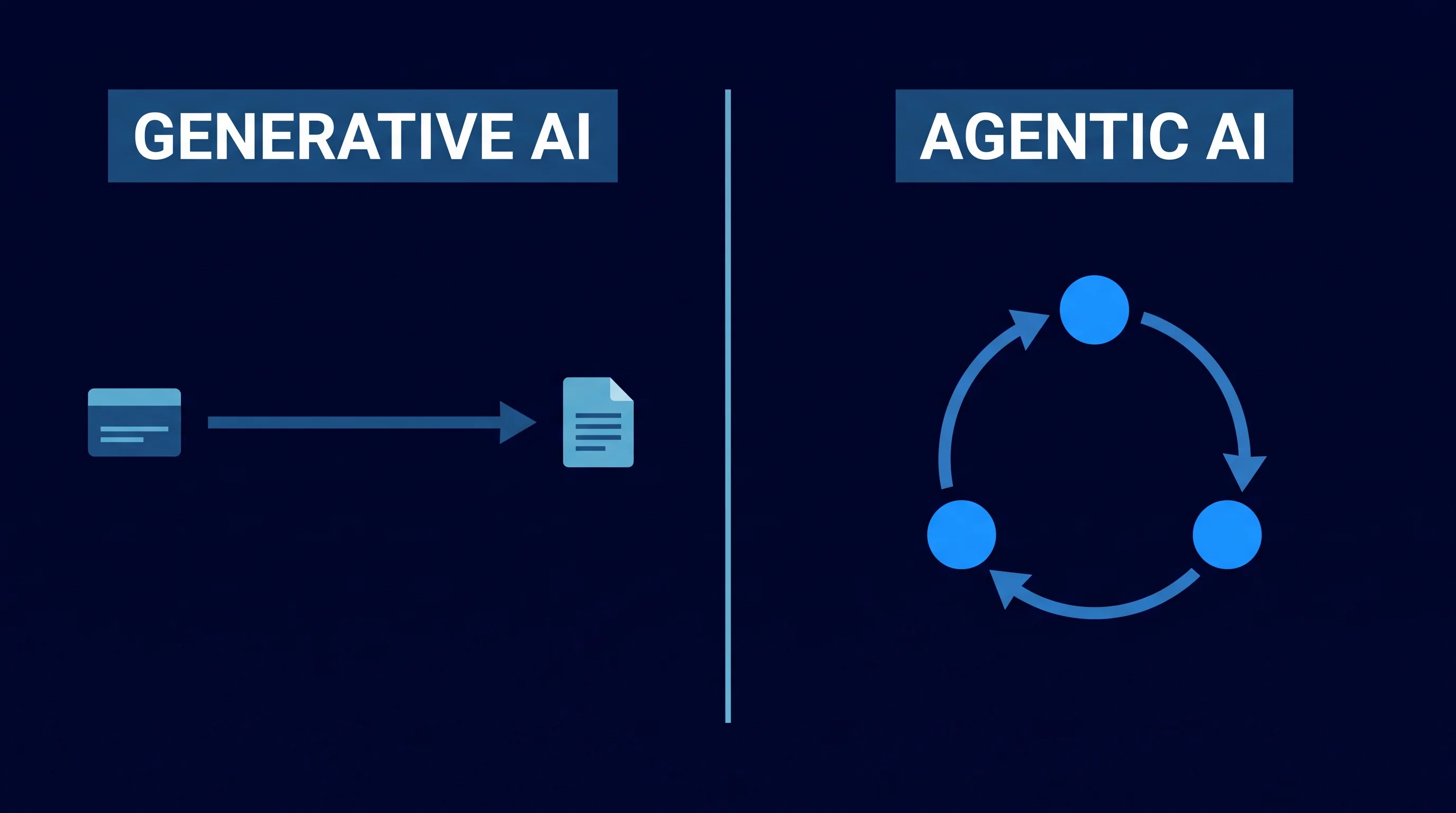
The difference between generative AI and agentic AI comes down to one question: who takes the next step? Generative AI delivers an answer: a piece of text, an image, or a block of code. A person reviews that answer and then acts on it themselves.
Agentic AI works differently. The AI takes that next step itself, inside your existing systems, from pulling data to executing a decision.
If you equate AI with a chat conversation, you're missing a level. Chatting with AI is a solid starting point, but it's only the first rung of a longer ladder. Agentic AI sits one rung higher: not just producing text, but acting on it.
That distinction isn't obvious yet if your main experience of AI is a chat window. When companies say they're already doing something with AI, they almost always mean using ChatGPT or Copilot for text. That's the first rung. The next rung is where AI also takes over the execution, not just the wording.
For the full explanation of what agentic AI actually involves and how the technology works, read our in-depth guide to agentic AI. This article focuses specifically on the difference with generative AI and what that difference means for your business processes.
Generative AI generates an answer. Agentic AI carries out the next step itself.
Generative AI is the technology behind ChatGPT, Claude, Copilot and Midjourney. The model learns patterns from large volumes of text, images or code, and generates new output based on those patterns.
That makes it strong at specific tasks: drafting a first version of a text, summarising a document, generating an image, suggesting code. As long as a person reviews the output and takes the next step themselves, this is exactly what the model was built for.
What generative AI doesn't do matters just as much. The model remembers nothing from your last session, has no access to your CRM or ERP, and waits for a new prompt after every answer. Without a separate layer of workflow automation on top, it stays text on a screen.
Ask generative AI to send an email, and the model writes the text but sends nothing. Ask it to change a booking, and it describes how you'd do that yourself. The execution stays with you. The model can also misstate facts without flagging it, which means human oversight remains necessary regardless of which level of AI you're using.
Deloitte research into generative AI in the enterprise found that most organisations are still in the experimentation phase, with limited progress toward business-critical processes (Deloitte, 2024).
A chatbot waits for the next question. It doesn't act on its own.
An AI agent uses a language model as its reasoning engine, but adds a layer on top: the ability to call tools, retrieve data and execute an action.
Anthropic describes this as a system in which the language model acts as orchestrator: it decides for itself which tool is needed at which moment, based on the current context (Anthropic, 2024). IBM puts the distinction in similarly concrete terms: generative AI responds to a prompt, agentic AI turns that output into an independently completed task (IBM, 2025).
In practice, an AI agent runs through a cycle of four steps, repeating it until the goal is reached. That's the cycle IBM describes as the core of every agentic system, regardless of sector (IBM, 2025).
Say an agent processes an incoming quote request: it reads the email, pulls the customer history from the CRM, puts together the quote and sets it up for approval. That's an illustration of the principle, not an example from a live project. But it shows what the difference means in practice: not a standalone answer to a prompt, but a chain of steps the system runs through on its own.
Agentic AI pairs reasoning with doing: the model decides the action and carries it out too.
The difference becomes concrete once you line up three dimensions: goal, output and risk.
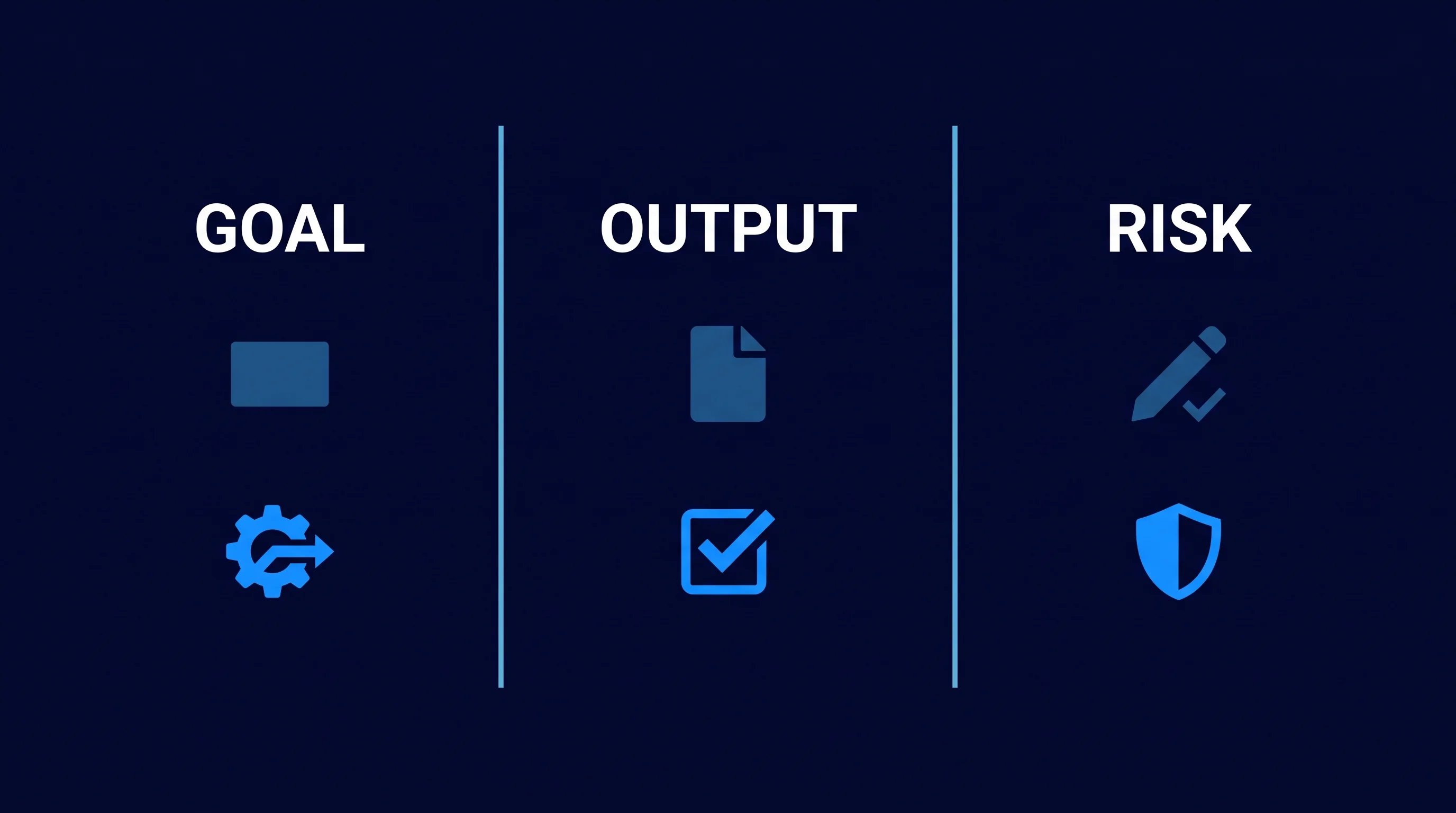
That risk side isn't theoretical. Fewer than 5% of enterprise apps had a task-specific AI agent in early 2025, a share Gartner expects to climb to 40% by 2026 (Gartner, 2025). A mistake in agentic AI hits a system. A mistake in generative AI only hits a piece of text.
The moment AI doesn't just generate text but carries out an action itself, the shape of the whole process changes. A task that used to consist of five manual steps becomes a process where an agent runs through four of those steps itself and flags the fifth for review.
Take an invoice process as an illustration, not as a concrete example from a live project but as a principle. With generative AI, an employee drafts a reminder email about an outstanding invoice faster, but still types and sends it themselves. With agentic AI, the system flags the outstanding invoice, drafts the reminder and sends it, with a human check on amounts that fall outside the norm.
That's a difference in who takes the last step, not just in speed.
Concretely, two things usually change in a process once you move from generative to agentic AI:
In the Netherlands, 22.7% of companies with 10 or more employees used AI technology in 2024, compared with an EU average of 19.95% (CBS, 2025; Eurostat, 2025). Most of those applications still sit at the level of text and documents, not at the level of agents that act on their own.
Want to know which steps in your process lend themselves to this approach? AI Agents & Process Automation maps that out for you, before you invest in an implementation.
The process doesn't change because AI gets smarter. It changes because AI takes over the last step.
With agentic AI, something can go wrong that simply can't go wrong with generative AI: not just a bad sentence, but a bad action inside a system. That's exactly why human-in-the-loop oversight, error handling and logging belong in the design, not bolted on as an afterthought.
The McKinsey State of AI 2025 survey found that 23% of organisations worldwide are already scaling an agentic AI system in at least one business function, and that 39% are experimenting with one (McKinsey, 2025). At the same time, Gartner predicts that more than 40% of agentic AI projects will be scrapped by the end of 2027, often due to unclear business value or missing controls (Gartner, 2025).
For Dutch SMEs, this means two things at once: the early adoption phase is happening right now, and the projects that stall usually do so from a lack of scoping, not from the technology itself. Waiting until the technology is fully mature isn't a neutral choice: companies that try out a first process now are building experience that competitors who do nothing yet will miss out on. That advantage doesn't sit in the technology itself, but in the lessons you learn about your own processes, data and exceptions.
Three things to sort out before you start:
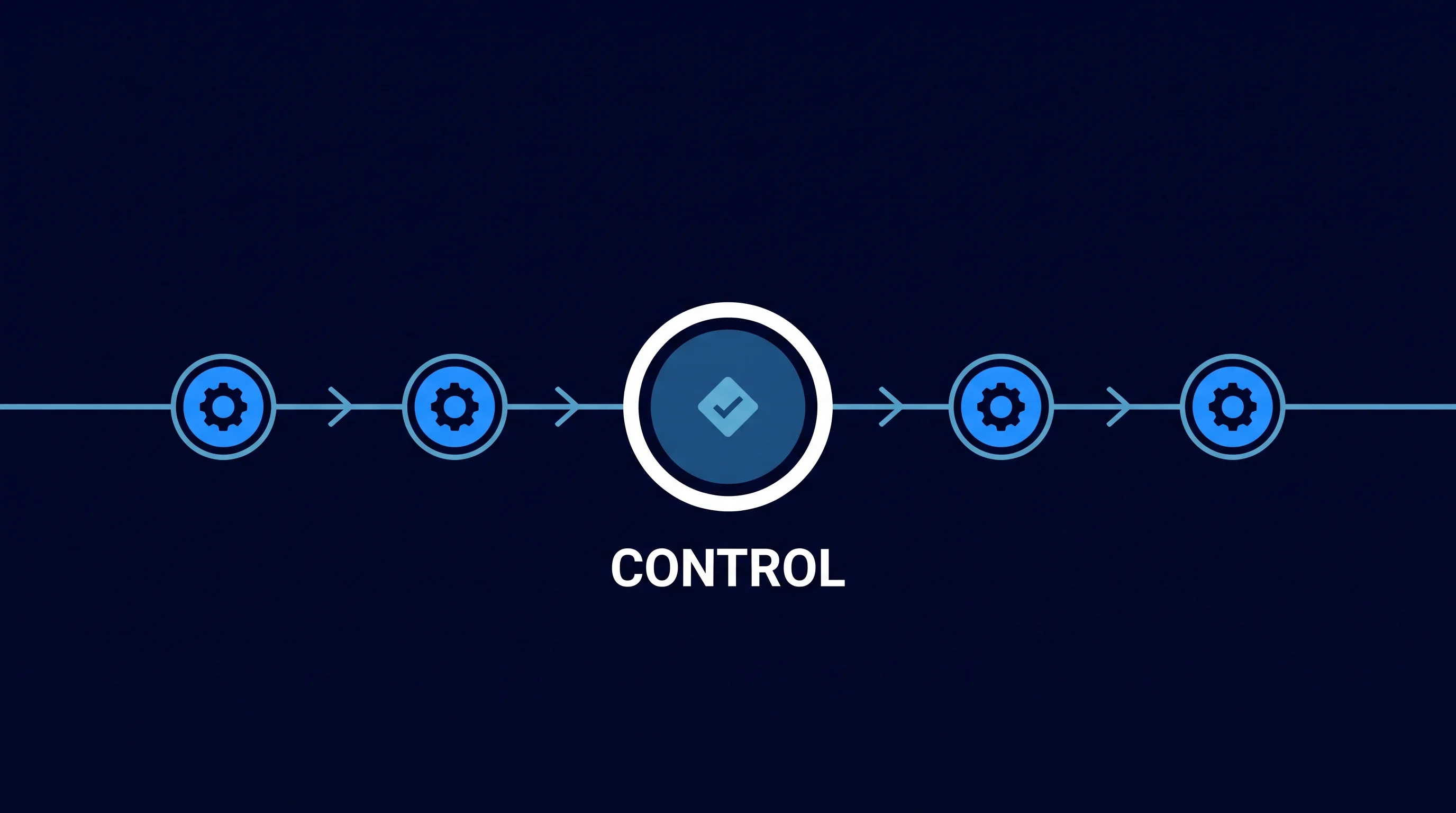
Anyone who sorts out these three points before the first agent goes live avoids most of the risks that generative AI simply never had.
The question isn't whether you use AI, but which rung of the ladder you're standing on.
Generative AI produces output like text, images or code based on a prompt, then waits for the next question. Agentic AI uses that output as a basis to carry out an action in your systems itself, without a person approving every step. The distinction is about who takes the last step: with generative AI, that's always a person; with agentic AI, it can be the AI itself.
ChatGPT's chat interface is generative AI: you ask a question, the model answers, and then it waits. Some variants get agentic extensions, such as calling tools or browsing the internet, but the core function stays generating an answer. The moment a system decides for itself which action to take in an external system, you're talking about agentic AI.
Yes, within the boundaries you set. An AI agent can retrieve data, make a decision based on fixed criteria and carry out an action, such as creating a booking or sending a message. For exceptions or amounts outside the norm, you build a human check into the process, so the agent doesn't act on its own outside the agreed boundaries. You set those boundaries yourself: how much room an agent gets is a design choice, not a fixed property of the technology.
The risk sits somewhere else, not automatically higher. A mistake by generative AI produces an incorrect text that a person still reviews. A mistake by agentic AI can produce a wrong action in a system, such as a message sent to the wrong person or an incorrect booking. That's why human-in-the-loop oversight, error handling and logging belong in the standard design of an agent, not as an add-on afterward.
Not strictly necessary, but practical. Agentic AI uses a generative language model as its reasoning engine, so the underlying technology overlaps. Companies already used to generative AI for text and concepts recognise more quickly which processes are suited to an agent that acts on its own. Experience with generative AI isn't a requirement, then, but it does help you form realistic expectations of what a language model can and can't do as a reasoning basis.
Processes that are repetitive, have structured or semi-structured input, and run in systems with API access. Think invoice processing, customer communication for recurring questions, or updating records in a CRM. The more clearly you can describe the process, the simpler the first implementation. Processes that mostly need human judgement and context are, for now, better served by generative AI as a support tool.
A commonly used and illustrative example, not a description of a specific project: an agent that reads incoming invoices, recognises the data, prepares the booking in the accounting package and only flags amounts outside the norm to an employee. We start every implementation with exactly this kind of concrete, well-scoped process, measure the result, and only expand after that.
Now that you know the difference, the next question is how agentic AI works in your own systems. We show you exactly where that starts.


.svg)