



Kronehoefstraat 85
5612 HL Eindhoven
BTW NL863902509B01
Connecting Carerix to AI: From Standalone System to Part of Your AI Business Brain
qw
vc
mshm
.svg)



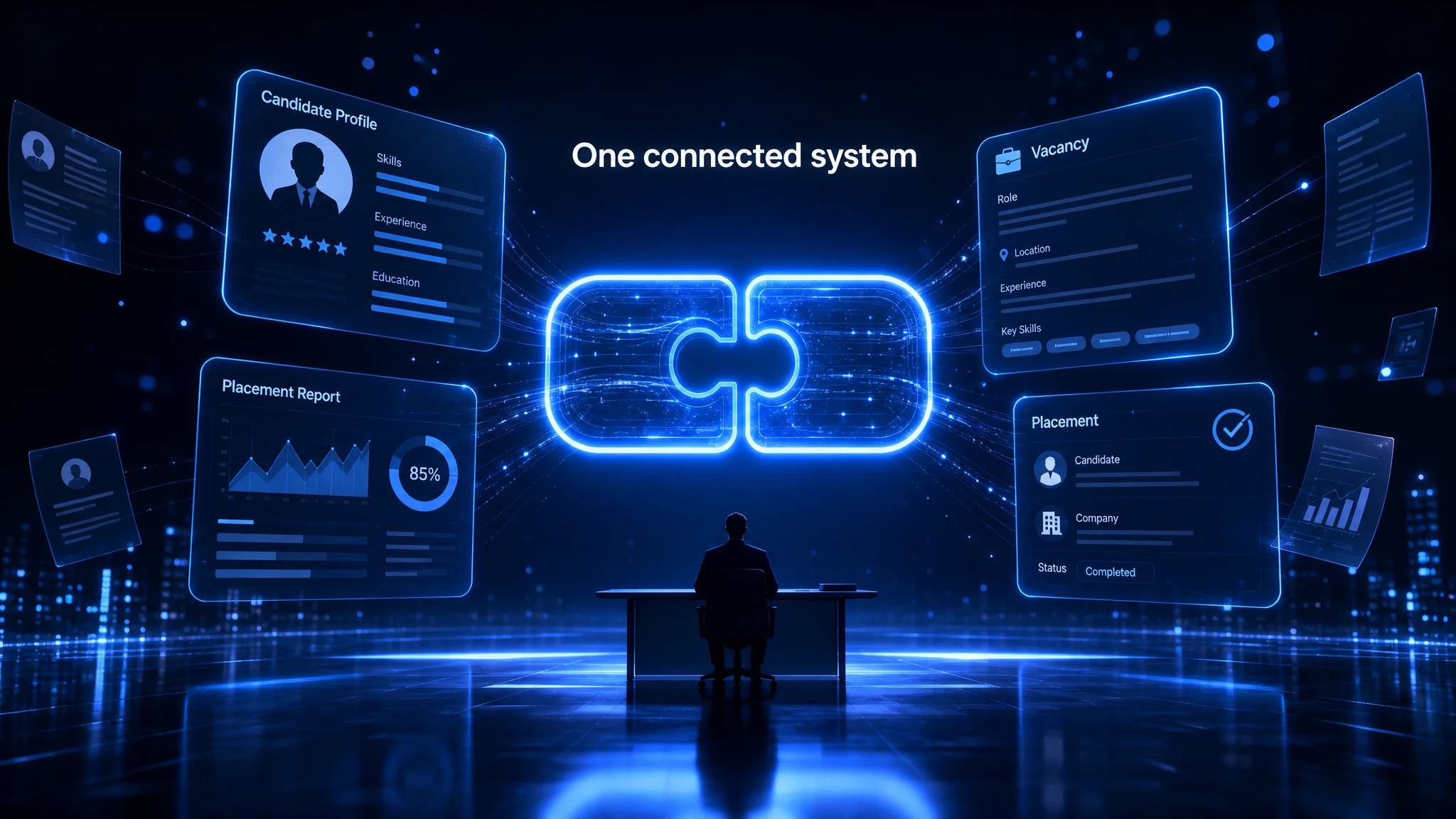
For staffing agencies, Carerix is often the best-in-class ATS, but the candidate and placement data inside it stays isolated until someone connects the system. A REST API integration unlocks that data for the rest of the organisation, so AI agents can match, follow up and report on it without anyone copying data by hand.
For many Dutch staffing agencies, Carerix is the ATS of choice: the system where vacancies, candidates and placements get managed every day. Carerix describes its own REST API as stable, robust and backwards compatible, so an integration keeps working without much maintenance (Carerix, 2026).
The problem isn't Carerix. The problem is what happens to the data once it's inside Carerix.
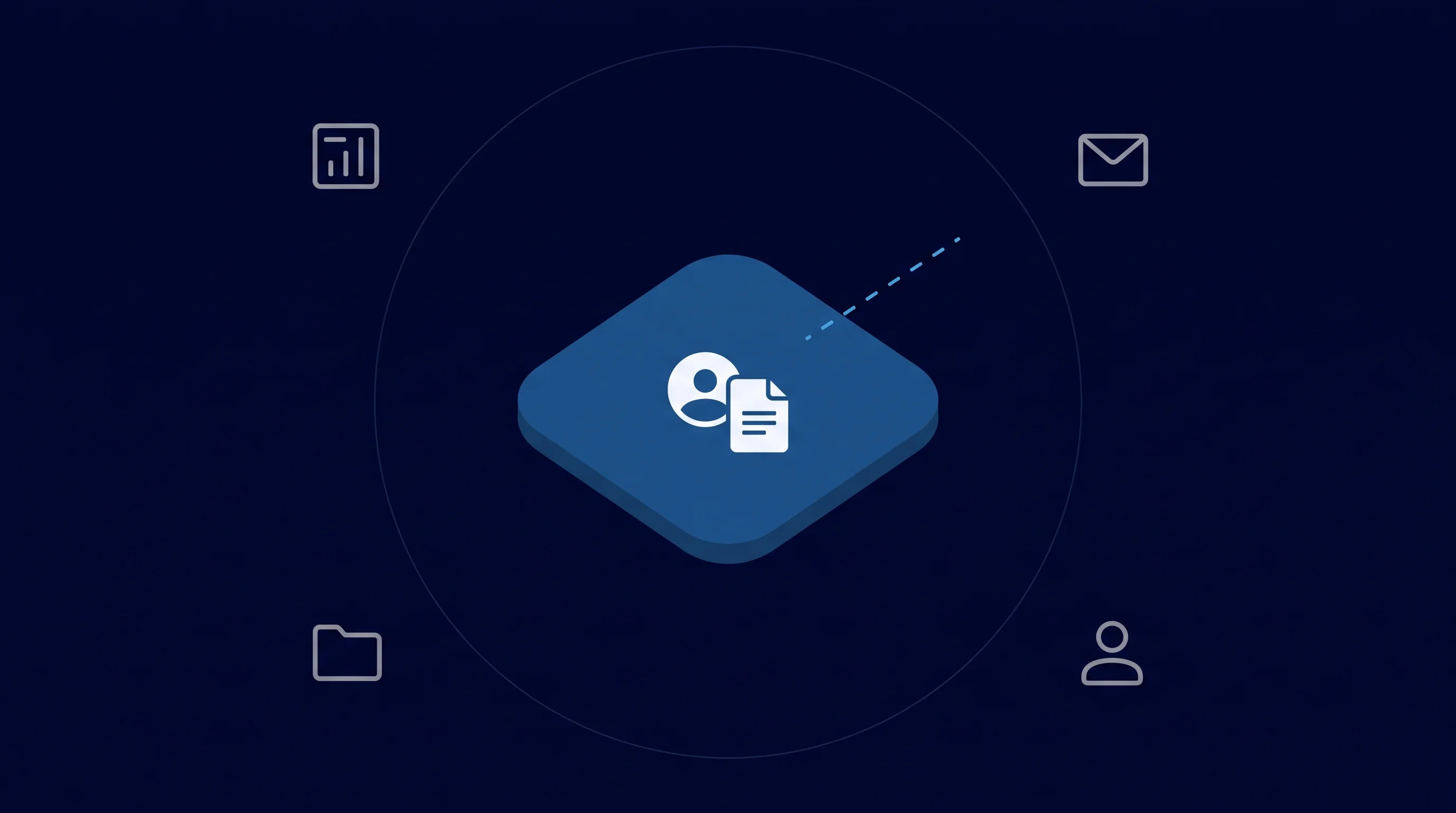
Without an integration, candidate and placement data lives only in Carerix. The rest of the organisation, from account management to reporting to a separate CRM, copies it out by hand to do anything with it. That fits a pattern that goes well beyond recruitment: the 27th annual HR Systems Survey from Sapient Insights Group, covering 3,318 organisations and 274 technology vendors worldwide, shows just how sprawling the average HR technology landscape has become (Sapient Insights Group, 2024-2025 HR Systems Survey).
A system that doesn't connect is a system you're only using at half its value.
That isolated feeling is exactly the pattern we run into time and again in leadership conversations: companies are already sold on AI and enjoy using standalone tools, but stall the moment they try to scale that across the whole organisation. Carerix is no exception. It's often the best-in-class ATS for a staffing agency with 10 to 100 employees, but without an integration it stays a system on its own instead of part of your AI Business Brain.
Double entry feels small each time and adds up fast over a year. A recruiter who updates a candidate status in Carerix and then retypes that same status into a report or a follow-up email loses a couple of minutes each time. Multiply that by dozens of candidates a week and it turns into hours that never show up on anyone's schedule.
The loss isn't just time. It's delay and errors: a candidate status that's long been updated in Carerix but still shows "in interview" in the report file. A follow-up that never happens because nobody retyped it in time. A placement number in the monthly report that's slightly off from what Carerix itself shows.
McKinsey calls unlocking backend systems through APIs one of the fastest ways to make data instantly available across the organisation, instead of exporting and importing it separately (McKinsey, 2017). That's the difference between an integration and an export: an integration works on live data, an export is a snapshot that's already outdated the moment it's ready.
An export is yesterday's photo. An integration lets you watch live.
The rest of the hiring cycle also consists of steps that demand coordination. Benchmark research from SHRM on the US labour market shows how fragmented the path from vacancy to offer really is: screening and interviews each take an average of 8 to 9 days (SHRM, 2025). Every handoff between systems is a chance for delay, and that starts with whether candidate data flows out of Carerix to the rest of your organisation at all.
For a staffing agency with 10 to 100 employees, this usually plays out at three fixed moments: the weekly update to the client, the monthly report to leadership, and the follow-up email to a candidate who's gone quiet for a while. All three run on the same underlying data, and for all three, someone still has to go back into Carerix by hand to check whether the information still holds. That's not an extra task someone accidentally picked up. It has quietly become part of the job, which is exactly why it never makes it onto the agenda as a problem in its own right.
Carerix offers its own broad REST API, alongside webhooks that automatically notify other systems the moment something changes in Carerix (Carerix, 2026). For the integration itself, that means two building blocks working side by side.
The REST API lets another system, such as your AI Business Brain, request or update specific candidate, vacancy and placement data from Carerix. That replaces manual copying with a request that gets answered in seconds.
A webhook sends a notification straight from Carerix the moment, say, a candidate status changes, so other systems don't have to wait for a manual export or a fixed sync schedule.
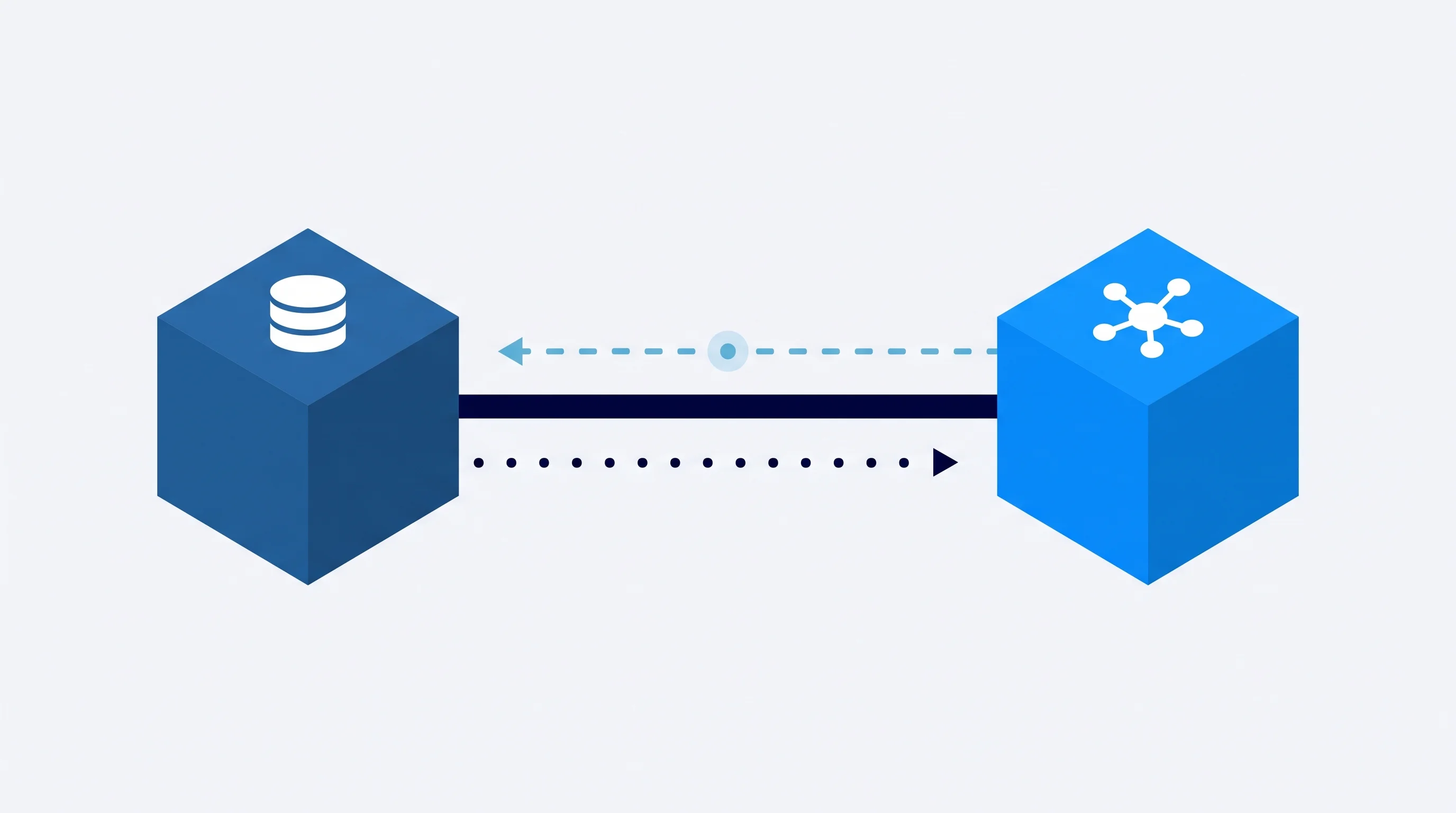
This is exactly what we build as a Business Apps & Integrations partner: no screen scraping or standalone workflow automation running on exported files, but a direct integration on the REST API. For Carerix specifically, we built that integration ourselves, see our Carerix integration page for what that looks like in practice.
An integration isn't a standalone project. It's the foundation the rest of your AI Business Brain runs on.
Who keeps ownership of the data also matters. A well-built integration doesn't change that: Carerix stays the owner of the source record, the integration only exposes what the agents working with it actually need. No full copy of your entire candidate database sitting somewhere else, only a targeted pull of what a specific task requires.
That distinction sounds technical, but it's exactly where an integration succeeds or fails. Dumping a full copy of your Carerix database somewhere else feels faster at first, but it creates a second place where candidate data can go stale or end up in the wrong hands. A targeted integration on the REST API takes a bit more upfront thinking: which fields does an AI agent need for matching, which for reporting, and which not at all. You make that call once, when you build the integration, instead of over and over with every export.
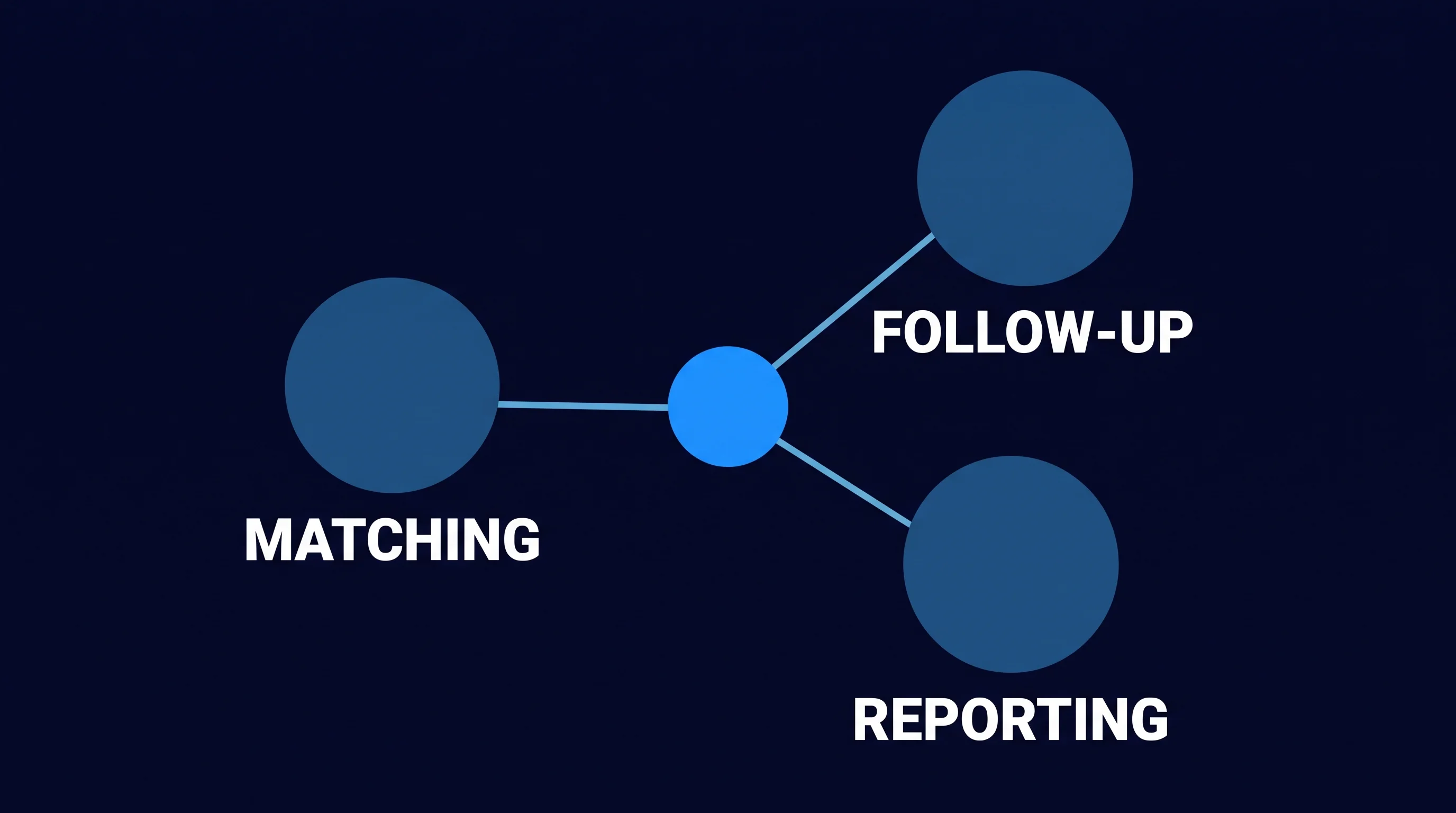
Once Carerix is connected, AI agents can work with live candidate and placement data instead of last week's export. That opens up three concrete use cases for a staffing agency.
An AI agent compares open vacancies in Carerix against the current candidate pool and flags a match the moment a candidate profile changes, instead of a recruiter checking it by hand.
A candidate who's gone quiet for two weeks automatically triggers a nudge to the responsible recruiter, based on the current status in Carerix, not a list someone last updated a week ago.
Placement numbers and time-to-fill flow straight from Carerix into a reporting agent, without anyone pulling a monthly export into a spreadsheet and adding it up by hand.
The difference between this way of working and the classic situation is easy to see side by side.
None of these three use cases replace the recruiter. They remove the copying so there's time left for the conversation with the candidate and the client, the part of the job an agent doesn't take over.
An integration that matches and reports is only valuable if it's also safe. Candidate data is personal data, and personal data calls for a careful approach, not a quickly built demo that ends up sticking around.
Three things come up in practice every time.
The Dutch data protection authority, the Autoriteit Persoonsgegevens, advises deleting applicant data no later than four weeks after a hiring process ends, with an extension of up to a year if the candidate consents (Autoriteit Persoonsgegevens, 2025). An integration has to follow that rule too, including in the system the data moves to after Carerix: no copy sitting somewhere out of sight.
The updated NVP Recruitment Code from September 2025 tightens the guidelines on using AI in, for example, CV screening and matching: organisations must be transparent about that use and be able to explain why a candidate scores higher or lower (NVP, 2025). That applies just as much to an AI agent matching on Carerix data as to a standalone screening system.
An AI agent flags a match or drafts a follow-up email. A recruiter reviews and sends it. That human-in-the-loop step isn't a detour, it's exactly what separates an agent you trust from one you have to double-check afterwards.
Fast isn't the same as well-built, and with personal data that difference is felt immediately.
That's also why we'd rather spend a bit more time on an integration than ship a quick demo that breaks after the first update. Gartner predicts that more than 40% of agentic AI projects will be canceled by the end of 2027, often due to rising costs, unclear business value, or inadequate risk controls (Gartner, 2025). An integration that accounts for retention periods, error handling and human-in-the-loop from the start avoids exactly that scenario.
The result of an integration isn't that Carerix disappears. Carerix stays the ATS heart of your recruitment work. What changes is what happens to the data once it's entered.
Staffing agencies that actually put AI to work in their workflow, instead of experimenting with it on the side, show that difference in their results too. The Bullhorn GRID industry report, covering nearly 2,300 recruitment professionals worldwide, found that 78% of agencies with revenue growth of 25% or more have embedded AI tools into their ATS workflow, and that 56% of the fastest-growing agencies achieve an average time-to-fill under 10 days (Bullhorn, 2026). Leaders who felt equipped to steer AI adoption were nearly 40% more likely to be responsible for revenue growth in 2025 than leaders who didn't (Bullhorn, 2026).

At the same time, most of the sector is still early in that journey: only 10% of agencies have woven agentic AI through their entire workflow (Bullhorn, 2026). That's exactly the step from "a standalone system" to "the whole organisation": not another isolated pilot, but the jump to something robust and repeatable running across the entire business.
For a staffing agency, that means in practice: digital workforce agents matching, following up and reporting on live Carerix data, without a recruiter ever having to copy anything between systems by hand. Carerix stays the system recruiters work in. It just finally becomes part of something bigger than itself.
The win isn't a new system next to Carerix, it's finally letting Carerix talk to the rest of your organisation.
For more on how these kinds of integrations work across broader business processes, also read how ERP integrations eliminate copy-paste work or how AI agents automate business processes.
Carerix is a Dutch ATS (applicant tracking system) where staffing agencies manage vacancies, candidates and placements. Many agencies consider it one of the strongest ATS platforms in the sector, precisely because it's built specifically for recruitment.
Carerix offers a REST API that lets another system request or update specific candidate, vacancy and placement data, plus webhooks that automatically send a notification the moment something changes. An integration partner builds that connection to fit exactly which data needs to go where.
In practice, it's mainly candidate profiles, vacancy requirements, placement status and contact moments. Together, that data is exactly what an AI agent needs to match, follow up or report without any separate copying.
Yes, as long as the integration accounts for retention periods, access control and human-in-the-loop review. The Autoriteit Persoonsgegevens advises deleting applicant data no later than four weeks after the hiring process, and that rule needs to apply in the connected system too.
That depends on how many systems you want to connect and which AI agents you want working on the data afterwards. A targeted integration for a few concrete use cases, like matching and reporting, is a smaller step than building a full AI Business Brain in one go.
It supports them. An AI agent flags a match or prepares a follow-up, but a recruiter reviews and decides. That human-in-the-loop step keeps quality and the client relationship in the hands of the people who understand it best.
Yes. The integration works on Carerix's REST API, independent of whatever other systems you use. Many staffing agencies run Carerix alongside a separate CRM for account management, and that's exactly when an integration is most valuable, because otherwise the data never comes together anywhere.
Carerix stays the ATS heart of your recruitment work, but the data inside it becomes usable across the rest of your organisation: no double work, no separate Excel exports, just AI agents working with live candidate and placement data.


.svg)