




Kronehoefstraat 85
5612 HL Eindhoven
BTW NL863902509B01
AI sales prospecting: how to use AI agents to fill your pipeline
qw
vc
mshm
.svg)



The average B2B salesperson spends 2 to 4 hours per day on prospecting: building lists, finding contact details, writing messages, and following up. That is time not spent in actual conversations with prospects.
The numbers confirm the problem. According to the Salesforce State of Sales Report (2024), salespeople spend only 28% of their time actually selling. The rest goes to administration, research, and list building.
For smaller sales teams, the norm in Dutch SMEs, that problem is larger. One or two salespeople who also handle prospecting simply cannot reach the volume needed to keep a healthy pipeline full.
The core problem: manual prospecting does not scale. AI-driven prospecting does.
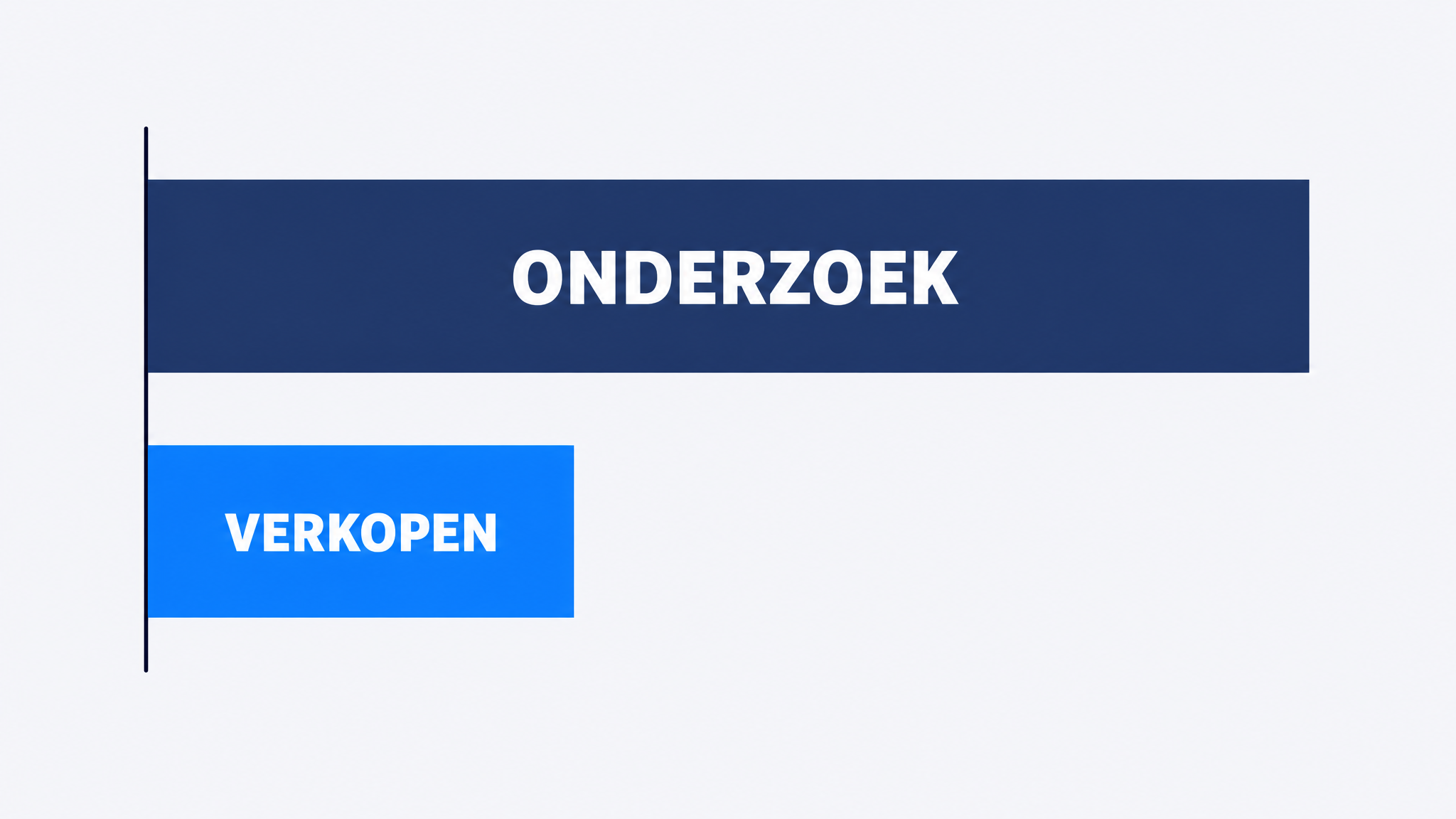
There are four tasks where AI is consistently better or faster than a human salesperson. And two tasks where human judgement remains irreplaceable.
A working AI prospecting workflow follows a consistent logic. Below are the five steps that successful teams use.
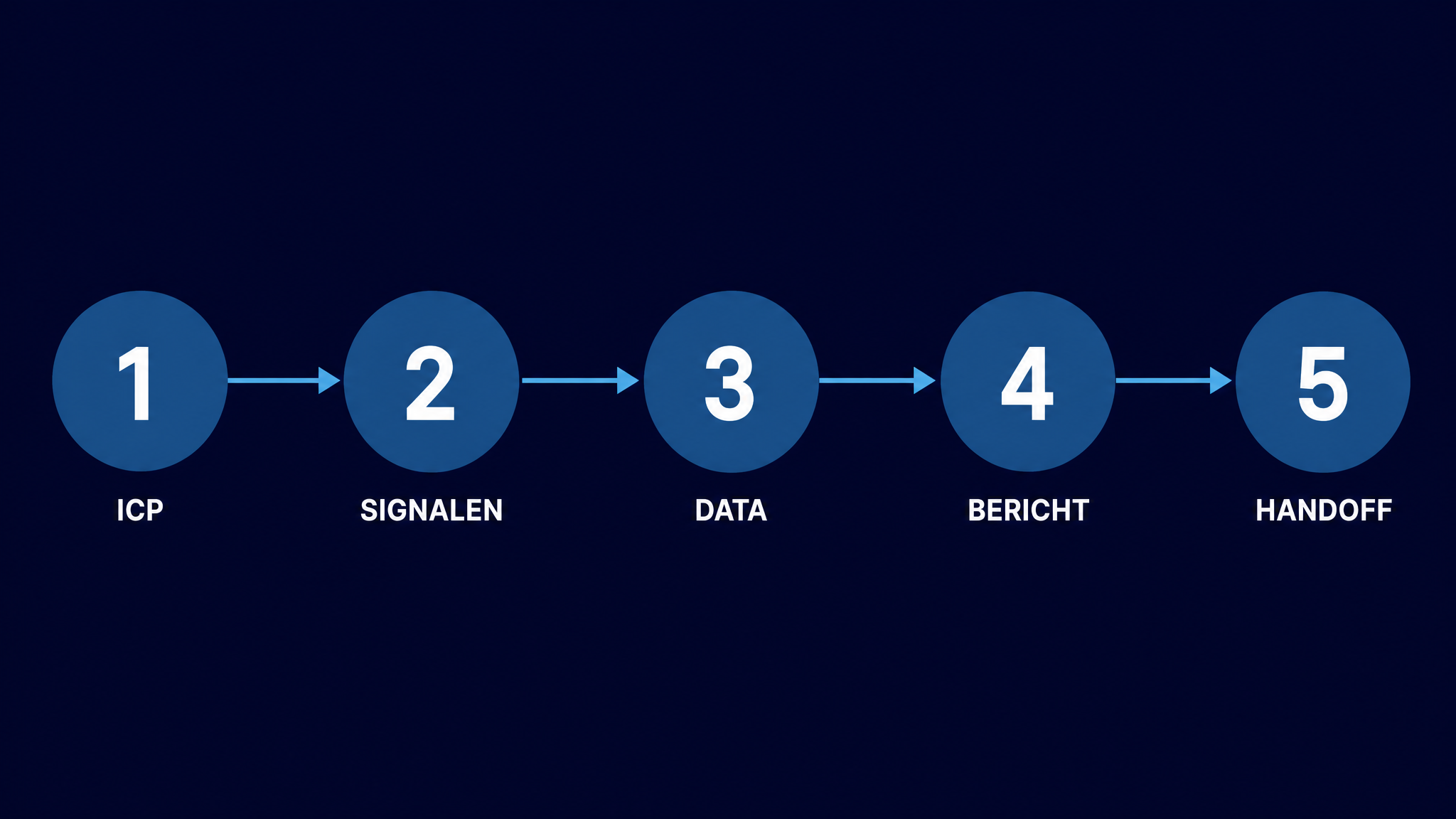
AI is only as good as the criteria you give it. Start with a sharp ICP: industry, company size, geographic focus, tech stack, and the decision-maker's job title. The more specific, the more relevant the list your AI builds.
Tools like Clay or Apollo.io search multiple data sources simultaneously: LinkedIn, Crunchbase, job boards, and company websites. Your settings determine which signals are relevant: a new investment, a growing department, a job posting for a role that your service would make redundant.
For each prospect on your list, AI enriches the contact details: verified email address, direct phone number, LinkedIn profile, and recent content the person has shared. Apollo claims 96% accuracy on contact data, making manual searching unnecessary for most cases.
Based on the gathered context, an AI agent writes a first message per prospect. Not a template with a name inserted, but a message that responds to a specific company event or pain point. Teams applying this approach see reply rates of 15 to 25%, according to research by Autobound (2026), versus the industry standard of 3 to 5%.
The outreach tool (HeyReach for LinkedIn, Lemlist or Instantly for email) sends the messages and monitors the follow-up. When a prospect responds positively, the contact is passed directly to your CRM for a human salesperson to pick up. The AI stops the moment human contact begins.
There are two fundamentally different ways to use AI for prospecting. The choice depends on the maturity of your sales process and the size of your team.
For Dutch SMEs, the copilot approach is often the better starting point. You keep control over the quality of your outreach while automating most of the research work.
The AI prospecting stack typically has three layers: data sources, an enrichment layer, and an outreach tool. Below are the most commonly used combinations.
You do not need to implement everything at once. Start with Apollo or Clay plus your existing CRM, add outreach when the base data is reliable, and layer in automation as volume grows. Learn more about how AI agents for process automation work on our service page.
Three metrics give the most honest picture of whether your AI prospecting contributes to growth.

Industry benchmark for cold email: 3 to 5%. With AI-driven personalisation based on buying intent signals, the best teams achieve 15 to 25%, according to Autobound (2026). If your reply rate is below 5%, personalisation is the first problem to solve, not volume.
How much it costs to generate one qualified conversation. Teams combining AI with human SDRs reduce their CPQO from an average of $487 to $224, a 54% reduction, according to data from Outreach (2025).
How much of your desired quarterly revenue is in your pipeline. AI prospecting helps keep this ratio stable: fewer peaks and troughs because the machine continuously brings new prospects into the funnel, even when your salespeople are busy closing deals.
Teams using AI effectively report 10 to 25% pipeline growth, according to multiple platform reports from 2025. Sales teams using AI are 1.3 times more likely to see revenue growth than those without, according to the Salesforce State of Sales Report (2024).
Want to build a structured approach? Read about AI strategy for your sales process on our strategy page.
Most teams disappointed in AI prospecting made one of these three mistakes.
Curious how an AI sales agent works in practice? See our AI sales agents service page for an overview of what we build and how.
AI sales prospecting means using AI agents for the repetitive steps in your sales process: finding the right prospects, enriching contact data, and writing personalised outreach messages. The AI replaces the manual research and message preparation; your salesperson takes over once there is a positive response.
Partially. An AI SDR can independently prospect, enrich, write messages, and follow up, but the sales conversation itself remains human work. Most successful teams use AI as a copilot: the AI does the preparation work, the salesperson runs the conversation. Fully autonomous AI SDRs work best for teams with a large, well-defined ICP and proven outreach scripts.
The most common combination: Clay or Apollo.io for data enrichment, HeyReach or Lemlist for outreach automation, and n8n or Make for connecting to your CRM. The exact stack depends on whether you prospect primarily via LinkedIn or email, and how complex your ICP is.
By genuinely personalising based on current context: a recent announcement, a job posting, a LinkedIn post from the prospect. AI-generated templates with only a name inserted barely outperform generic cold email. Use buying intent signals as triggers, and keep your daily outreach volume low enough to protect your domain reputation.
The HubSpot Sales Trends Report (2025) shows that 64% of salespeople save 1 to 5 hours per week through AI automation. Teams that automate the full prospecting workflow report savings of 4 or more hours per day in research work. What you save depends on your ICP complexity and the volume you prospect.
Yes, and in many cases it is even more valuable for small teams. A small team without a budget for additional SDRs can match the output of a larger team with AI. Start with the copilot approach: AI builds the list and writes the drafts, the salesperson reviews and sends. That gives you control without the overhead of a fully automated system.
Most outreach tools offer native integrations with HubSpot, Salesforce, and Pipedrive. Clay and Apollo sync contacts and activities directly to your CRM. If you use a less common CRM, n8n or Make provides an API connection. The key is a clear trigger: which event in your outreach tool creates a deal in your CRM?
Tool costs vary: Apollo starts around $50 per user per month, Clay uses a consumption model that depends on how many records you enrich. The larger cost is implementation and setup: defining the ICP correctly, building the workflow, and calibrating the personalisation. A hybrid approach (AI copilot) is cheaper to start than a fully autonomous AI SDR.
The Agentic Group builds AI sales agents that fill your pipeline while your team focuses on the conversations that matter. Not separate tools: a working system that integrates with your existing CRM and outreach stack.


.svg)