



Kronehoefstraat 85
5612 HL Eindhoven
BTW NL863902509B01
Automating Approval Workflows: Why Human-in-the-Loop Isn't a Weakness
qw
vc
mshm
.svg)



Last updated: 2026-07-15
Automating an approval workflow means an AI agent takes over the routine work: reading the data, matching it to the rules, and escalating only what falls outside the agreed boundaries. Human-in-the-loop isn't a brake on speed here, it's the design that decides who gets the final say. Get that right, and you gain time without losing control.
The moment automation comes up in the context of an approval step, distrust follows. Not because people are against technology, but because money, a supplier, and a signature are involved. "A bot will approve my invoices" isn't an exaggerated fear. It's a logical reaction to a system you can't see working.
That fear has a real basis. Reported AI incidents rose to 362 in 2025, up from 233 in 2024 (Stanford HAI, AI Index Report 2026). Automation without oversight does go wrong sometimes. That's exactly why a good approval workflow isn't about handing everything to an agent, it's about craftsmanship: knowing which part of the process an agent can handle, and which part a human still needs to see.
The fear isn't irrational. It's a signal that calls for good design, not for no automation at all.
Craftsmanship isn't an abstract word here. It means deciding in advance which decisions an agent may make on its own, how you catch a mistake before it causes damage, and how you can reconstruct afterwards what happened. That's exactly the work that makes the difference between an agent you trust and one you switch off after the first mistake.
In this article, we show what it actually takes to automate an approval workflow without losing control: from evals to exception handling to logging, and why human-in-the-loop is a deliberate choice here, not a stopgap.
An approval workflow is the fixed sequence of steps between the moment something comes in, such as an invoice, a purchase request, or a contract, and the moment someone signs off. In most SMEs, that sequence still runs largely through email: someone forwards it, someone else reads it, replies, or forgets to reply.
That process breaks down in two places. Volume: the more requests come in, the greater the chance something gets left behind. And consistency: one time someone checks an amount carefully, the next time that same person clicks approve between two meetings.
The numbers confirm that manual processing isn't simply a matter of too little discipline, it's a process that structurally produces errors. Nearly four in ten invoices contain a mistake, such as a wrong amount, missing data, or an incorrect match to the purchase order (HighRadius, 2025). At organisations without automation, the exception rate sits around 14%, and 53% of AP teams call exceptions their biggest operational problem (Billed, 2026). The gap in processing cost between manual and automated runs as high as 4 to 6 times per document, with processing time dropping from 17.4 to 3.1 days among top performers (Ardent Partners, 2025).
The problem isn't that people approve poorly. The problem is that every approval moment demands the same attention, whether it's a routine invoice or an exception.
That distinction, between routine and exception, is exactly where an AI agent for process automation adds value: it recognises the difference and treats it accordingly.
For most SMEs in administration, construction, and staffing, the same pattern holds: the bulk of requests are standard, and only a small share genuinely require judgement. A workflow that doesn't make that distinction treats both the same way, and that's where the time leaks away.

Human-in-the-loop means a human keeps the final say over anything that falls outside the pre-agreed rules. That sounds like a compromise, like something you add because the technology isn't far enough along yet. The opposite is true.
An agent that handles everything independently, including the cases where it's actually not sure, isn't a more mature system. It's a system with no brakes. Human-in-the-loop is the brake you build in yourself, while you still can.
That principle is now written into law, too. The EU AI Act requires that high-risk AI systems be designed so a human can effectively oversee them: understand what the system can and can't do, intervene, and reverse a decision (EU AI Act, Article 14, 2024). That obligation for high-risk systems takes effect on August 2, 2026. For an approval workflow involving money, contracts, or personal data, this isn't distant regulation: it describes what a well-designed system should already be doing anyway.
One of the five required competencies under Article 14 is awareness of automation bias: the tendency to follow an AI output blindly, even when it's wrong. For an approval step, that means concretely that the person reviewing an escalation must genuinely be able to deviate from what the agent proposes, not just tick the box on paper.
In practice, the employee's role shifts. Instead of assessing every request themselves, that person only reviews what the agent can't handle on its own. Less volume, more attention per decision.
Building an approval agent isn't a matter of writing a prompt and going live. Three components determine whether an agent is actually trustworthy.
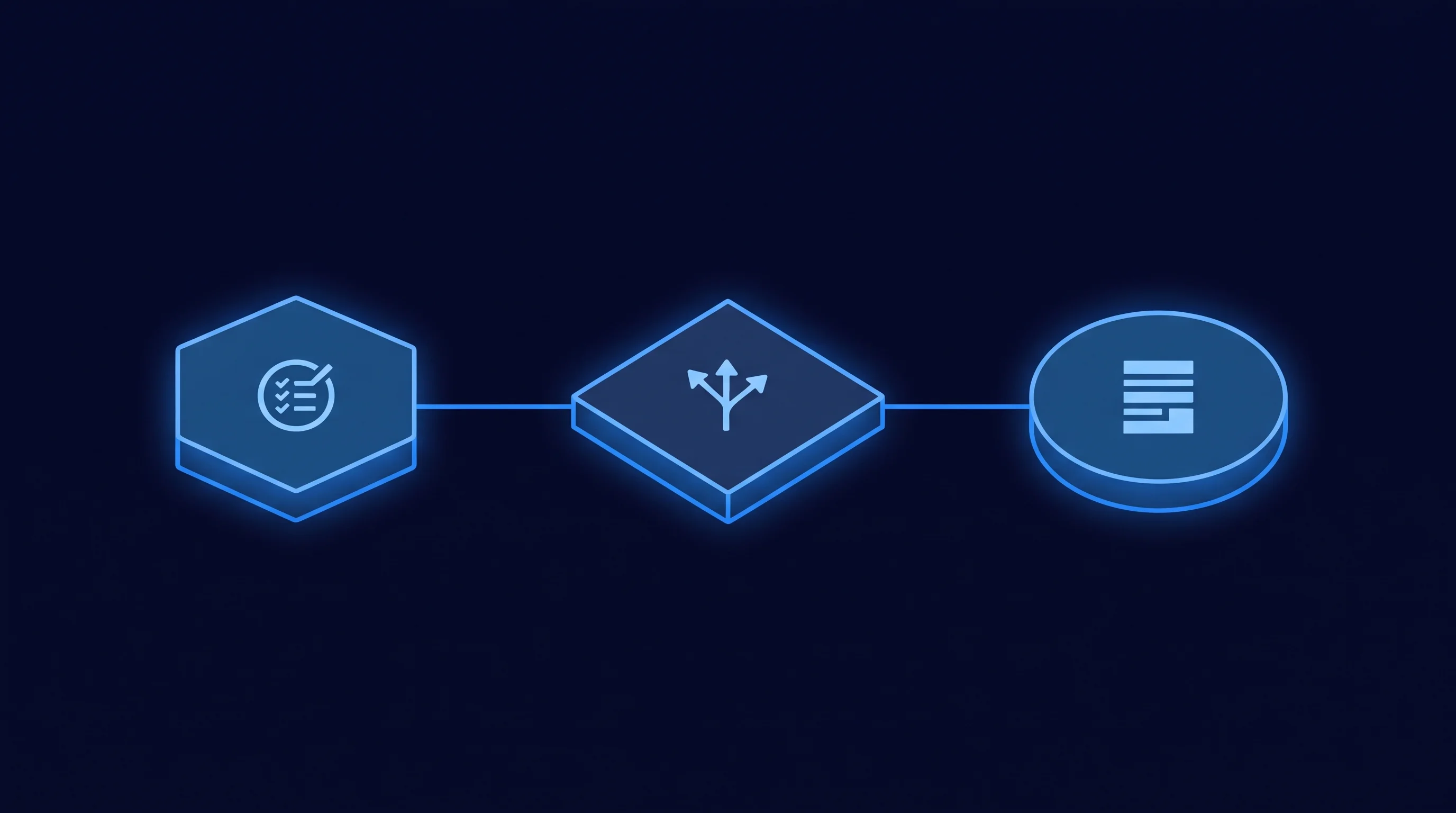
Evals. Before an agent is allowed to touch a real approval, we test it against hundreds of past cases: known invoices, known exceptions, known edge cases. Only once the agent consistently makes the right call, or consistently escalates when it's unsure, does it go live. That test set keeps growing: every new exception the agent encounters in production gets added to the next test round after review.
Exception handling. Every agent gets something wrong occasionally. Exception handling is the design that determines what happens next: the agent stops, flags what went wrong, and sends a structured notification to the right person instead of quietly posting the transaction anyway. That notification always includes what's needed to decide quickly: what the agent saw, which rule didn't check out, and what the options are.
Logging. Every decision, automatic or human, gets recorded: what came in, which rule applied, who signed off. Without a log, an approval can no longer be reconstructed, and that's exactly the risk that makes companies wary. That log isn't there because you distrust the agent. It's how you build trust: every decision can be explained after the fact.
This craftsmanship has a business side, too. Gartner predicts that more than 40% of agentic AI projects will be cancelled by the end of 2027, mainly due to rising costs, unclear business value, and insufficient risk management (Gartner, via Forbes, 2026). Projects that fail rarely do so because the model was too weak. They fail because nobody set up the evals, the exception handling, and the logging beforehand.
This lines up with the broader pattern we see in business process automation with AI agents: the difference between a pilot that stalls and a system that actually scales comes down to exactly this kind of design work.
The question is never "do we automate the approval or not." The question is which part goes automatic, and which part stays a checkpoint. For invoice approval, that line looks like this in practice.
This line isn't fixed. As the agent runs longer and the evals show that a category performs reliably, the threshold can shift. That's a deliberate, gradual adjustment, not a big bang where you let go of everything at once.
An approval step that can't be reconstructed isn't automation, it's a black box. Auditability starts with three things: what came in, which rule was applied, and who made or confirmed the decision.
For intelligent process automation involving money or personal data, GDPR comes into play too: if you process personal data of suppliers or contact people, you need to be able to show where that data lives and who can access it. Run on EU-based infrastructure, with a log that records what happened per transaction, and you meet that basic requirement and the core of Article 14 of the AI Act: a human can look back at any moment to see what the system did and why.
For an accountant or regulator, the question is always the same: can you show that the right person signed off at the right moment, and that an exception wasn't silently ignored? With a logging layer that records who, what, and why for every approval, that answer is an export, not a hunt through mailboxes.

A well-built log isn't something you bolt on afterwards for the accountant. It's the proof that the system does what you think it does.
This is also why, in our AI Agents & Process Automation work, we set up the logging layer first, not last. Want to see how that comes together with the rest of the process in practice? Also read intelligent process automation for SMEs, where we explain the full three-layer model.
An approval workflow is the fixed sequence of steps between a request coming in, such as an invoice or purchase order, and the moment of sign-off. With automation, an AI agent takes over reading, matching, and routing, and a human only reviews what falls outside the agreed rules.
No. Human-in-the-loop is a deliberate design choice that determines who has the final say under uncertainty. A system that handles everything independently with no checkpoint isn't more mature, it simply has no brakes built in.
Good exception handling makes the agent stop as soon as it's uncertain, flag the deviation, and send a structured notification to the right person. The invoice or request isn't quietly posted through when there's doubt.
You define in advance which deviations an agent may handle itself and which always escalate, such as a new supplier or an amount above a threshold. Every escalation comes with a clear explanation, so the human can decide quickly without having to figure out what went wrong themselves.
Standard cases with a known supplier, an amount below the agreed threshold, and a match with the purchase order lend themselves well to full automation. New suppliers, large amounts, and deviations from the purchase order remain a human-in-the-loop checkpoint.
By logging every step: what came in, which rule was applied, who made the decision. Run on EU-based infrastructure with that logging in place, and you meet the basics of GDPR and the human-oversight principle in Article 14 of the EU AI Act.
Industry figures show a 4 to 6 times difference in processing cost per document between manual and automated processing, with processing time dropping from 17.4 to 3.1 days among top performers. That's an industry average, not a promise for your specific process: how much time you save depends on your request volume and the share of standard cases.
The cost depends on how many systems need to be connected, the request volume, and the complexity of the rules, so we won't name a fixed amount here. We work with a defined pilot phase on one process, so you know the investment upfront before scaling further.
An approval step doesn't have to be a bottleneck, and it doesn't have to ask for blind trust. We build agents with control built in, so you stay in charge of what runs automatically and what a human still checks.


.svg)