



Kronehoefstraat 85
5612 HL Eindhoven
BTW NL863902509B01
From scattered systems to an AI Business Brain: the AI operating system for SMEs
qw
vc
mshm
.svg)




Last updated: 2026-06-12
An AI Business Brain, also called an AI operating system, is a connected layer that links all your business systems into one searchable whole. Your team and you ask it questions in plain language and let it take over work, with a source for every answer. For SMEs it replaces isolated AI experiments with a foundation that works across four layers: context, data, intelligence and automations.
Most SMEs run on five to ten separate systems. An accounting package, a CRM, a project tool, a shared drive, email. Each system does its job, but they do not talk to each other.
The average company now uses more than a hundred different SaaS applications (Okta Businesses at Work, 2025). More tools means more switching. And that switching lands on your team's plate.
Your systems do not talk to each other, so your team does that work by hand. Someone looks up the answer in email, copies an amount from the accounting system, and keeps the rest in their head.
Research puts a number on it. Workers toggle between applications and windows around 1,200 times a day, losing roughly four hours a week just re-orienting after each switch (Harvard Business Review, 2022). Taken together, about 60 per cent of knowledge workers' time goes to work about work: searching, switching, status updates and manual consolidation (Asana Anatomy of Work Index).
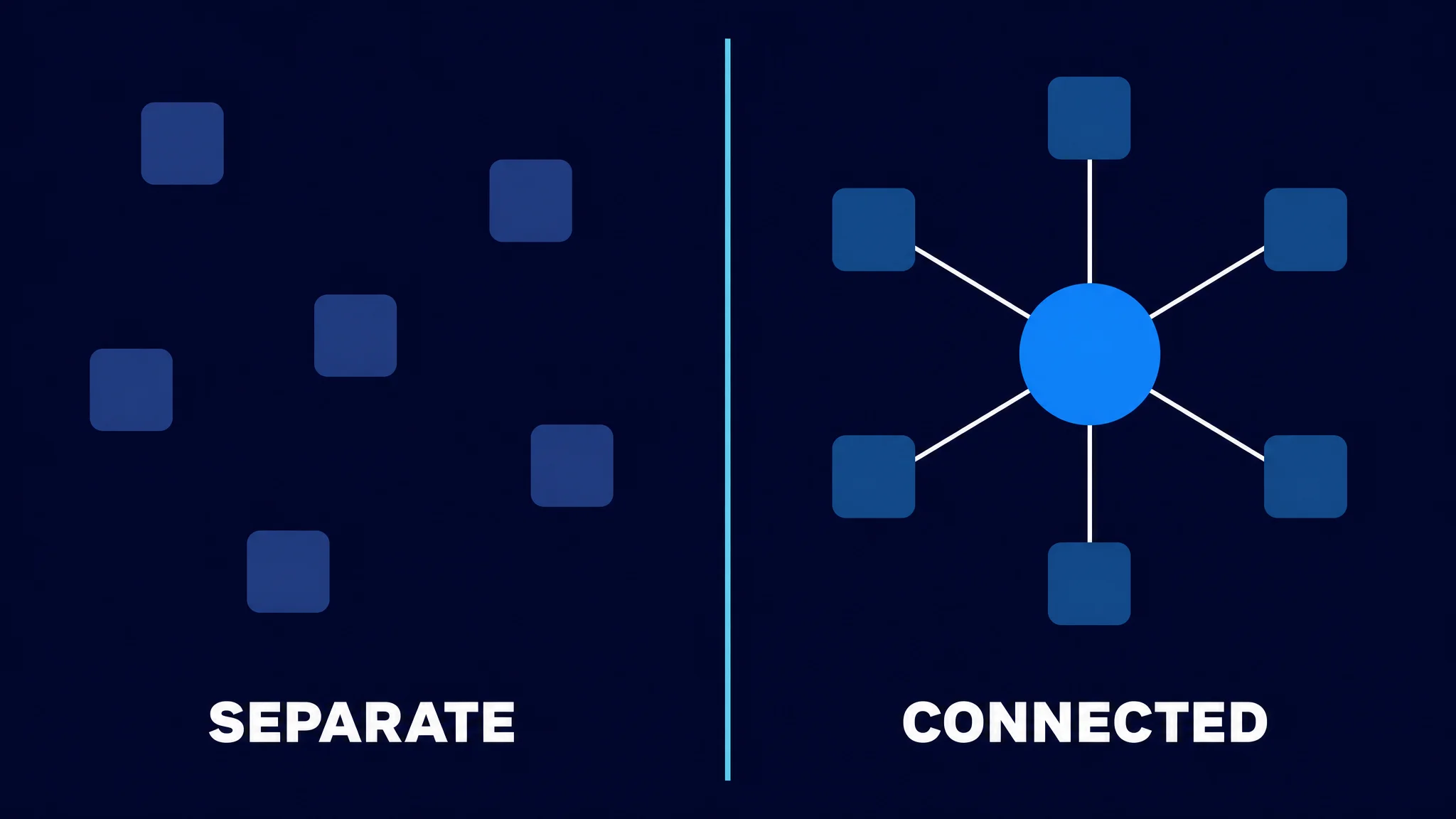
Here is what that looks like in practice. At a property manager with around 1,100 rental units, the recurring manual work of the back-office team added up to roughly 18 to 23 hours a week: triaging and routing email, looking up data across separate systems, assembling overviews from different sources. That is not laziness, it is the price of disconnected systems.
The pain sits in four places at once. Your first line cannot find the answer, so everything escalates to the second line. You cannot ask your own business data a question, so every overview needs someone to build a report. Repetitive work, think categorising email or producing standard documents, comes back every week. And your business information is searchable by AI nowhere, so every isolated AI experiment starts from scratch again.
The problem is not your software. The problem is that nothing sits between your systems.
An AI Business Brain is the layer that does sit in between. It connects your existing systems into one searchable source, learns the language and the processes of your business, and gives your team and you one place where everything comes together.
You do not have to replace your software. The brain lays itself on top. Your accounting stays your accounting, your CRM stays your CRM, but the information is opened up properly once and stays available after that.
The term AI operating system is a deliberate choice. Like the operating system on your laptop, it is the layer everything else runs on. It is not another app on the pile, it is the foundation underneath. If you want to understand how the underlying AI agents work, read what agentic AI actually is.
The difference with a single AI tool: a tool solves a task, a brain solves the coherence.
That distinction is not a detail. By now 88 per cent of organisations regularly use AI in at least one business function, but nearly two-thirds have not started scaling, and only about one in five has genuinely redesigned processes (McKinsey, State of AI 2025). In other words: most companies stack separate tools instead of laying a foundation.
An AI Business Brain reverses that order. Foundation first, applications second. That is exactly where isolated experiments go wrong: they stay isolated, so every next step starts from scratch.
You build an AI Business Brain from the bottom up, in four layers. Skip a layer and the layer above it does not work.
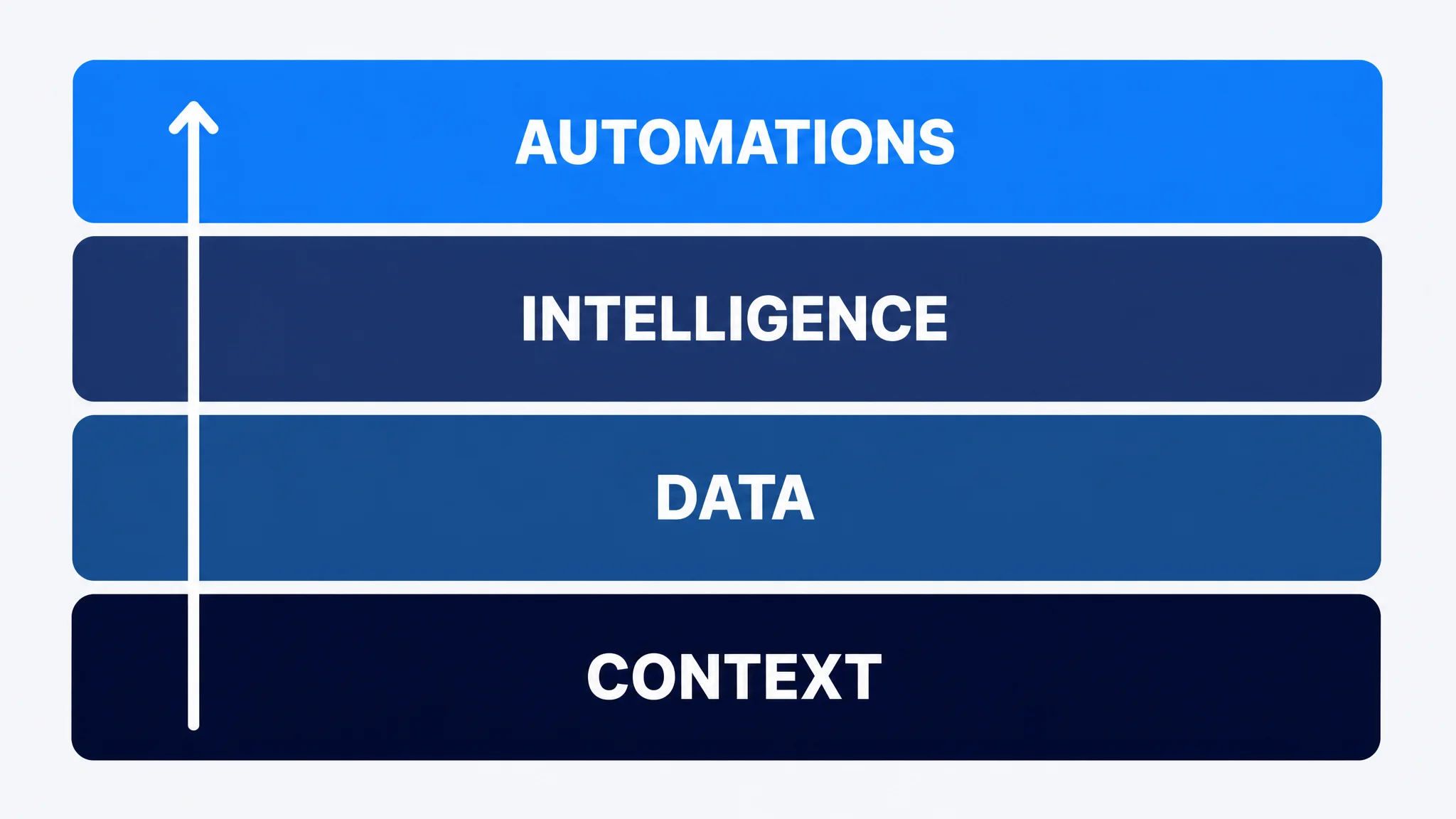
Context is the bottom layer: how your business works, who does what, which terms you use. Without context no AI understands your business, and you get generic answers instead of yours.
Data is the second layer: all your systems connected into one searchable source. No exports, no copy-paste, no six tabs open at once.
Intelligence is the third layer: asking questions in plain language, spotting patterns, answering with a source. "How many invoices are outstanding?" or "What is happening on this project?", with the answer in seconds.
Automations is the top layer: taking over work based on what the first three layers know. Briefings, draft replies and reports that write themselves.
The reason to start at the bottom is simple. An automation running on scattered data only makes mistakes faster. An automation running on a well-filled brain takes over work you used to do by hand.
Here is how the two approaches look side by side.
The four-layer model is no secret and no unique possession. It is the logical order to make AI work rather than impress.
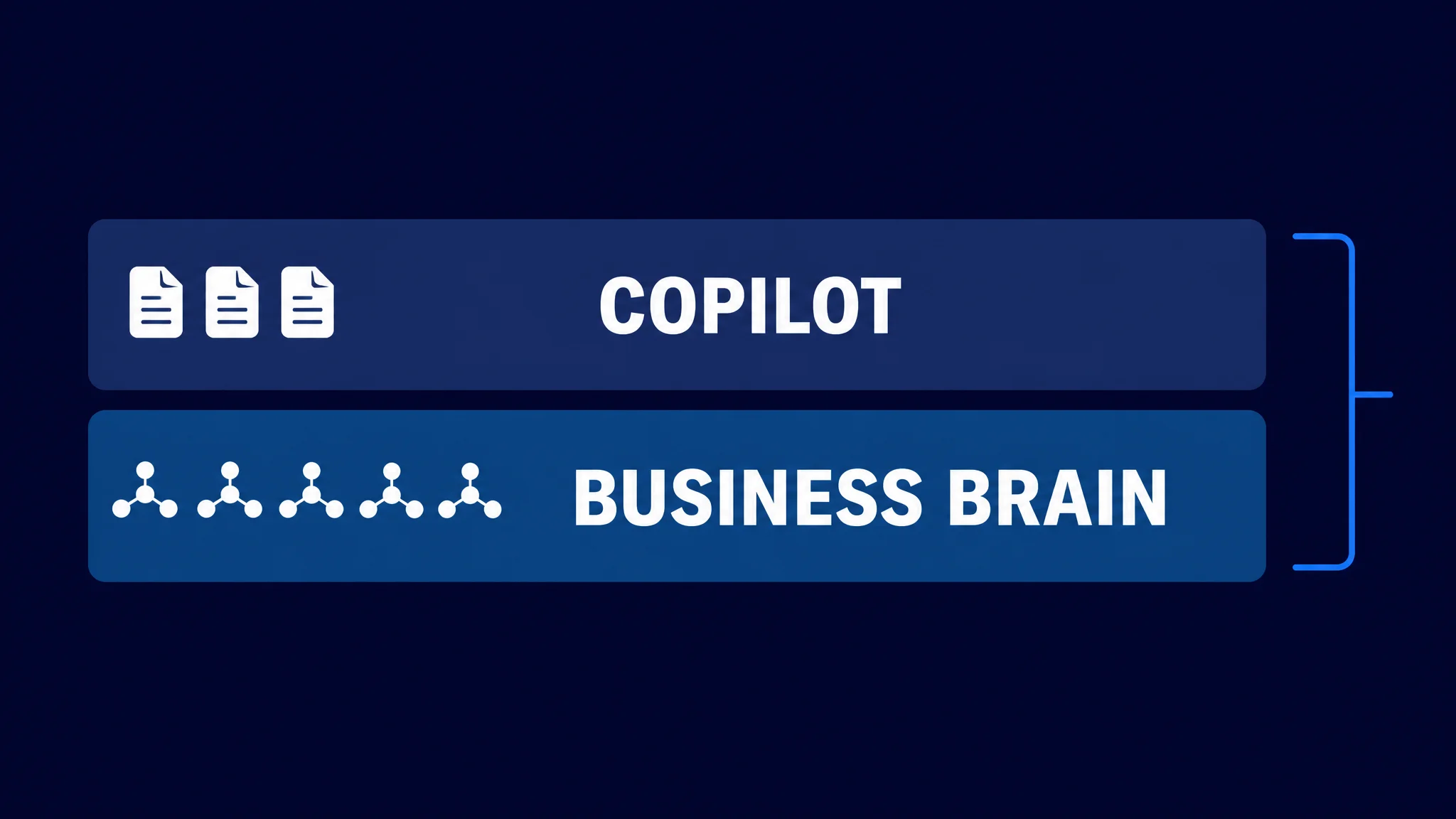
Many owners ask: do we not already have this with Microsoft Copilot? The short answer: Copilot and an AI Business Brain sit on a different layer. It is not another version of the same thing.
Copilot makes you faster inside your Microsoft documents. It summarises a Teams call, drafts a document in Word, builds a formula in Excel. Strong work, but it happens in the productivity layer, inside Microsoft 365.
An AI Business Brain sits underneath. It connects your whole operation, including the systems outside Microsoft: your accounting, your CRM, your industry software. Where Copilot stops, the brain begins.
There is another difference that matters for SMEs: access and data. A broad AI assistant inherits the permissions baked into your files, and those permissions are often too wide. On average 16 per cent of business-critical data is overshared, with hundreds of thousands of files per organisation accessible more broadly than intended (Concentric AI Data Risk Report). It is no surprise that 67 per cent of security teams worry that AI tools expose sensitive information (Metomic, 2025).
A well-built AI Business Brain handles permissions per role and does not train on your data. The large players are moving that way too: in October 2025 OpenAI launched Company Knowledge, which brings business data from separate apps together with sources and without training on that data by default (OpenAI, 2025). The difference for Dutch SMEs is the connection: a horizontal tool from the United States does not connect natively with AFAS, Exact or Moneybird, and does not speak the language of your packages.
Here is how they relate to each other.
They do not rule each other out. Copilot makes you faster in your documents, the brain makes your whole business queryable.
The gain is not abstract. The same brain, three kinds of operation, the same pains in a different context.
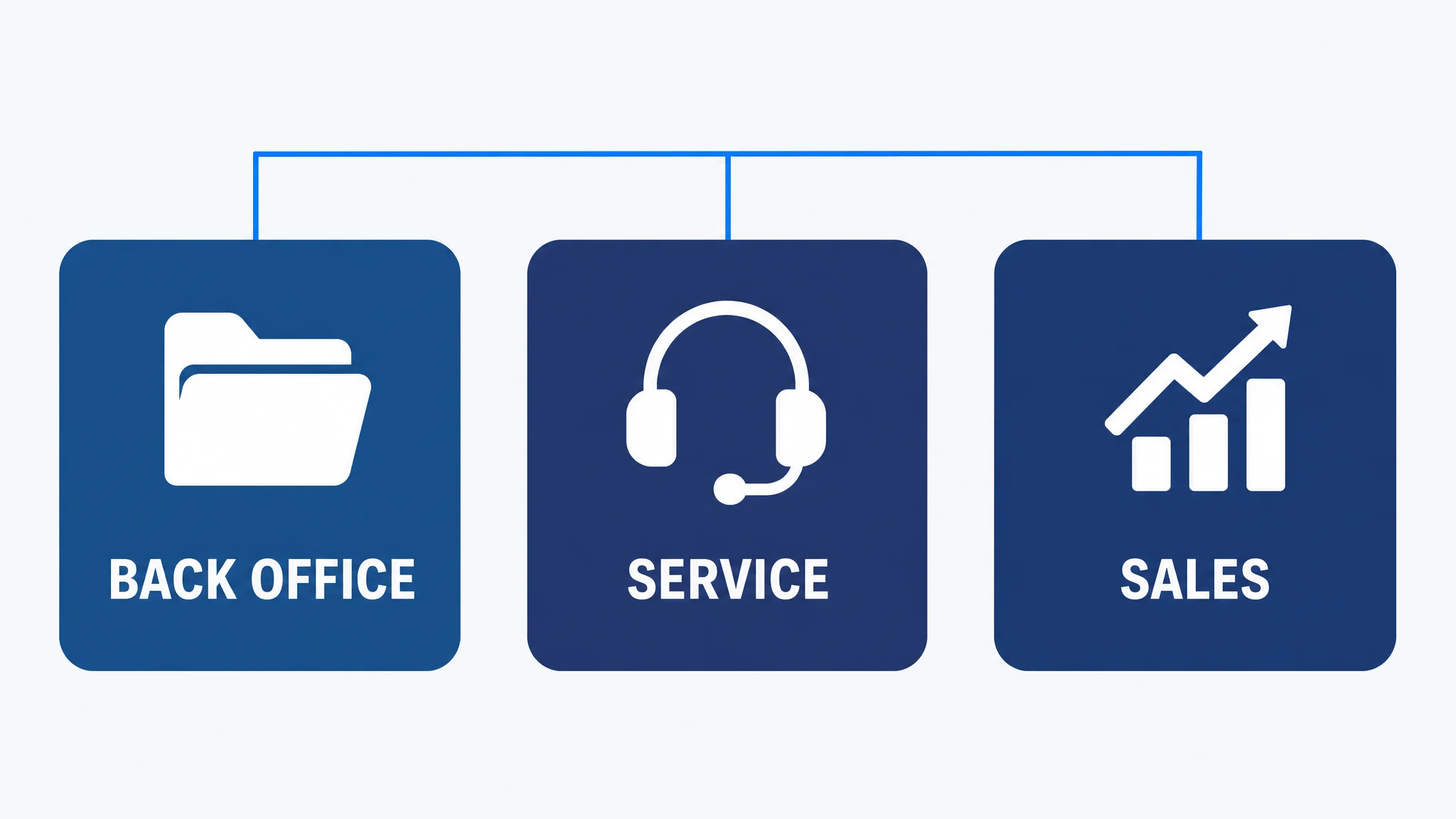
In the back office the recurring manual work disappears. At the property manager mentioned earlier it was that 18 to 23 hours a week, or at least half an hour per employee per day. Time that comes back for the work that does matter.
In the service operation the first line handles more itself. Where almost every question now escalates to the second line, the goal is to bring that back towards half within three months. The employee finds the answer themselves, the customer is helped faster.
In the sales operation the right information surfaces in one go: which lead is promising, what is happening on an account, without someone first walking through three systems.
Important: this is not about replacing people with a dashboard. The manual work disappears so there is more time for the customer, the team and the advice, not less. The brain takes over the searching, not the craft.
For Dutch SMEs the real value sits in three choices. The connection of your systems happens natively with Dutch packages like AFAS, Exact, Carerix and Moneybird. The data is EU-hosted and is not trained on, which fits the requirements of the EU AI Act that have applied to general-purpose AI models since August 2025 and tighten further in August 2026 (European Commission). And it is a standard solution of the right size, not custom work you need to drive yourself.
You do not build an AI Business Brain in a weekend, but you do start small. The first step is not choosing a tool, it is mapping your operation.
Start with an audit. It answers three questions.
Those three answers decide where the brain delivers a return first. After that you build from the bottom up. Context and data in order first, so the brain really knows your business. Then the intelligence layer, so your team and you can ask questions. And only once that stands, the first automations that take over work.
Not all at once, but a bit more every month. That is how you build a foundation that lasts, instead of another experiment that fizzles out.
The question is not whether you start with AI, but whether you lay a foundation or stack separate tools again.
A separate AI tool speeds up a single task, separate from your systems. An AI Business Brain connects all your systems into one searchable whole and forms the foundation every next AI application plugs into. The difference is coherence: a tool solves a task, a brain solves the fragmentation.
No. Microsoft Copilot makes you faster inside your Microsoft documents, in the productivity layer. An AI Business Brain sits beneath that and connects your whole operation, including the systems outside Microsoft 365 such as your accounting and CRM. They can sit side by side perfectly well.
Yes, and that is exactly the strong point for Dutch SMEs. An AI Business Brain connects natively with well-known Dutch packages like AFAS, Exact, Carerix and Moneybird. Horizontal tools from the United States usually do not.
With a well-built AI Business Brain, no. The data is EU-hosted, stays yours and is not used to train models. Permissions are handled per role, so employees only see what they are allowed to see.
You start small, with an audit and the first layers, and build from there. The first working results are usually there within a few weeks, not months. After that a piece of functionality is added every month.
No. An AI Business Brain lays itself over your existing software and connects to it. Your accounting stays your accounting, your CRM stays your CRM. The information is opened up properly once and stays available after that.
For SMEs of roughly 10 to 100 employees whose work is spread across five to ten systems and where the team does the manual work in between. The sector matters less than the situation. Real estate, administration, construction and recruitment recognise the pattern most strongly.
We build a connected AI layer on top of your existing software for Dutch SMEs, from strategy to working automations. Start with an audit of your operation and find out where the brain delivers time first.


.svg)