
Kronehoefstraat 85
5612 HL Eindhoven
BTW NL863902509B01

Back to case studies overview
Sunbit – n8n implementation for AI-native creative operations
qw
vc
mshm
.svg)



Sunbit is a US fintech that helps consumers pay for the bills they did not see coming: the car repair, the dentist, the vet. Behind that single moment sits an operation where marketing, sales, support and finance each run on their own systems. Salesforce for customer and partner data. Zendesk for support. Iterable for campaigns. Twilio for SMS. Slack for the daily work.
Those systems talked to each other through automations that had accumulated over the years. Each piece did its job. Together they did not form a system. There was no shared structure, no consistent error handling, and no single place to see what had failed and when. Changing one workflow meant searching through an environment nobody fully oversaw any more.
Sunbit wanted more than keeping what was there. They wanted a foundation that AI can run on: an environment where an agent can reach the right data, make a judgement, and finish its step without a human in the middle. That is what AI-native creative operations means: not bolting AI onto the process, but building the process so AI is a working link in it.
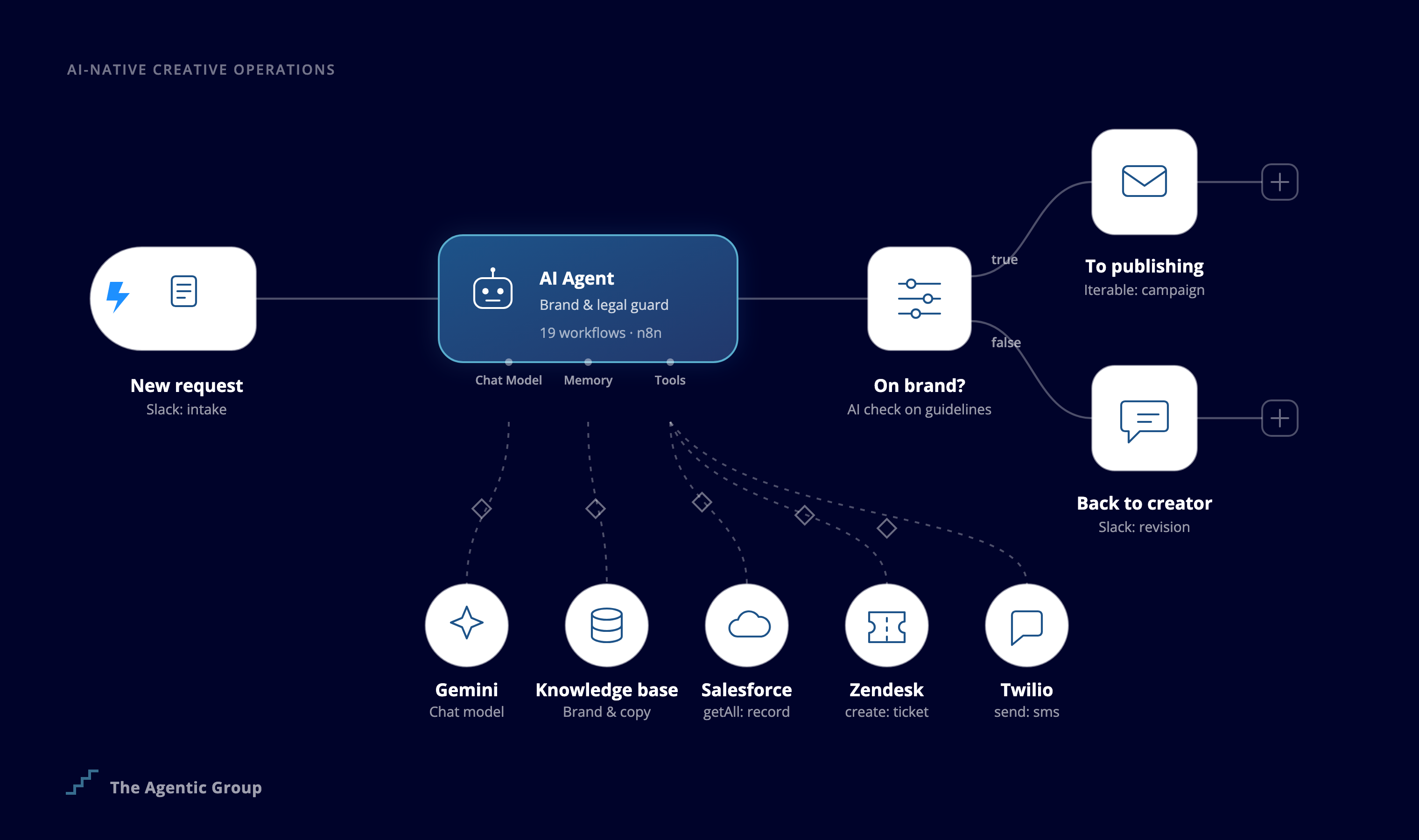
We rebuilt the entire automation layer in n8n. Nineteen workflows across three workspaces, each with the same structure, the same naming, and the same way of handling failure.
The workflows fall into four clusters. Requests and leads: web forms, demo requests and event registrations that land in Salesforce and are created or updated there automatically. Support and communication: Zendesk tickets that trigger an outbound SMS through Twilio, and customer replies that come back as a comment on that same ticket. Customer and partner processes: a signed contract, portal access for a new partner, a changed payment method, a paid settlement that lands as an event in Iterable. And campaigns: referral registrations and conversions that feed the marketing side automatically.
Every workflow is modular, with sub-workflows for the parts that recur in more than one place. Failures produce an explicit fail state with a notification, never silence. Every run is traceable through structured logging.
The AI in this system is not a chat window next to the work. It is a step inside the workflow that makes a judgement and passes it on. An agent completes a request before a human ever sees it, checks content against the brand and copy guidelines, or runs a legal pre-screen so only what clears that check reaches a specialist.
That only works if the agent can reach the right knowledge. So underneath the agents sits a central knowledge base: brand guidelines, copy guidelines and disclaimers, structured so both the workflows and the people on the team can work from them directly. We design that data layer first and build the agents on top of it. An agent is never better than the information it can reach.
Salesforce, Zendesk, Iterable, Twilio, Slack and Google Drive, plus the form and event tools the team uses to bring in leads. Where a ready-made connector existed, we used it. Where it did not, we built the connection ourselves on the system's API, with the same standards for retries, error handling and logging as everything else.
Sunbit has a dedicated team of 32 hours per week. Not a series of one-off assignments, but continuous capacity that moves things forward every week. That makes an approach possible where nothing switches over in one go.
Each workflow goes through the same steps: understand the business logic, build test data for every path the workflow can take, build it, test it in a separate sandbox, deploy to production, and verify there that it does what it should. Only then does the old version go off. The order was deliberate: we started with the smallest and safest workflows so the team could learn the environment without any risk to live operations. The heaviest workflow was scheduled last, at the point where the team was fastest.
Handover includes documentation per workflow: what it does, what it depends on, what happens when it fails and how to recover it. Plus runbooks for the AI agents, including the prompts and how to update them.
Thirteen of the nineteen workflows run live in production. The final six are being built. The agentic layer builds on the same foundation: now that the orchestration is in place and the knowledge base is set up, every next AI step is an extension rather than a new project.
[QUOTE ANGEL KEMPER, Sunbit: to be collected]
An n8n implementation means setting up a central automation layer where your systems work together. That is more than clicking workflows together: it means an environment with fixed build patterns, error handling, logging, monitoring and documentation, so it is still maintainable years later by someone who was not there when it was built.
n8n runs on your own infrastructure, so you decide where your data sits. For a financial company that is rarely a detail. It also extends with your own code where a standard connector falls short, and AI agents are a first-class part of it rather than an add-on.
Yes. We rebuild them rather than copy them one to one. An existing automation often carries workarounds that were once unavoidable. Rebuilding takes those out, and we run the old and the new version side by side until the new one is proven to do the same thing.
That depends on the number of workflows and how deeply they are tied into your systems. At Sunbit it was nineteen workflows across three workspaces, with a dedicated team of 32 hours per week. We work in two-week increments that each deliver something testable, so you are not waiting months for one big release.
We build automations in n8n for companies that want to move past scattered experiments. From rebuilding existing workflows to AI agents that make a real judgement inside the process.


.svg)