


Kronehoefstraat 85
5612 HL Eindhoven
BTW NL863902509B01

Back to case studies overview
GLMall – automating lead generation with AI for e-commerce shop acquisition
qw
vc
mshm
.svg)



GLMall is a marketplace. The business model only starts working once enough webshops are on it, which makes e-commerce shop acquisition not a marketing task but the engine under the entire company. That engine ran on manual work.
A merchant manager looked up webshops, clicked through the store to judge whether the category and catalogue were a fit, then hunted for contact details by hand and sent a message. Every shop costs minutes. Scaling that approach means scaling the number of people doing it. And every new region starts the story over, because the knowledge of where to look sits in people's heads rather than in a system.
So the question was not how to make merchant managers work faster. The question was whether acquisition could become a system that keeps running when nobody is sitting at it.
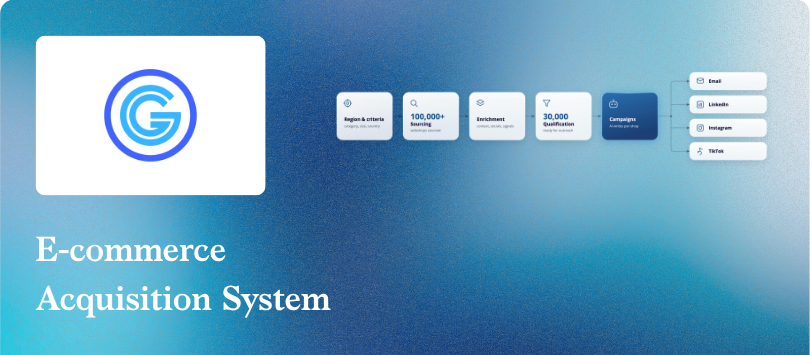
A chain of five steps, each one runnable on its own and each one resumable if it stops halfway. Everything comes together in a single database that is the source of truth, with a purpose-built control screen on top of it.
Per region we pull in webshops from specialised data sources, with GLMall's targeting rules applied on top: which categories are in and out, how large the catalogue has to be, which countries count. Duplicates are removed and every shop gets its own identity in the database. Opening a new region is therefore not a new project but a configuration.
A shop on a list is not yet a prospect. Every webshop is built out into a profile you can act on: contact details, social channels, country and currency, how deep the catalogue runs, how mature the store is, and whether it looks ready to sell across borders. Those last signals decide not only whether we reach out, but what we talk about.
The qualification step is deterministic on purpose. No language model, just plain testable rules: is there a valid email address, a phone number, or a social profile that actually resolves to an account rather than a platform homepage. Anything that fails is rejected with the reason recorded alongside it.
That is a deliberate choice. Putting a language model on this step makes it slower, more expensive and not reproducible, while the question itself is simple. We use AI where judgement is needed, not where a rule will do.
Outreach runs through campaigns with one channel per campaign. Sending accounts are a first-class part of the system: every message records which account sent it and at which step of the sequence. Before a webshop enters a campaign, the system checks whether we have already touched that shop on that channel, so nobody gets the same message twice.
The messages themselves come from an AI agent. It writes its own text per webshop and per step in the sequence, based on the enriched profile: the category, the size of the catalogue, the region. Not a template with a name slotted in, but a message about that particular store.
Email and LinkedIn are running, each through the sending infrastructure that belongs to it, with the platform's volume limits built in. Instagram and TikTok are designed as the next channels, based on measured reachability of the shops in the database rather than on gut feel. Replies are detected and flagged for a human: the system opens doors, the GLMall team closes the deals.
The system runs, but it does not run blind. There is a control screen where someone at GLMall sees what comes in and what goes out: which webshops were sourced, who passed qualification and who was rejected and why, which campaigns are live, and per webshop which messages are queued.
That is where the controls a human should hold actually sit. The brief per campaign, meaning what the messages should be about, is written by hand and only then does the agent generate. Anyone who replies lands with a person, not with the system's next step. And approving or rejecting a webshop by hand is always possible, with that choice sticking rather than being overwritten by the next run.
That is the difference between automation and autonomy. The repetitive work is gone, the decisions that matter still sit with the team.
Over 100,000 webshops have been sourced across India and Spanish-speaking Latin America. Of those, 30,000 are fully enriched, qualified and ready for outreach. Multiple campaigns are running.
The system is built to keep growing. A new region is a set of targeting rules, a new channel is an adapter on the same engine, and every campaign produces data on which messages work and which webshops actually convert. That data feeds back into qualification.
It rarely means AI does the whole process. At GLMall, ordinary software does the finding, enriching and filtering, because that is rule work you want to be able to reproduce and test. AI does the part that involves judgement and language: writing a message per webshop that is actually about something. That split keeps the system both affordable and reliable.
No. A bought list is a snapshot without context, and everyone who buys it emails the same people. This system builds the dataset itself against your criteria, enriches it with the signals that shape what you say, and tracks who was contacted when and on which channel.
Three things. Qualify on real reachability, so you never approach someone you only have a contact form for. Write per recipient instead of blasting a template. And respect each channel's volume limits, because an account that moves too fast gets blocked and then the whole channel goes quiet.
Yes. The engine is channel-agnostic and audience-agnostic. What changes is where you look and what you qualify on. The chain of finding, enriching, qualifying, writing and sending stays the same.
We build acquisition systems for companies that want to grow without hiring someone every time. From building your own dataset to AI agents that write per prospect.


.svg)