



Kronehoefstraat 85
5612 HL Eindhoven
BTW NL863902509B01
Building like an AI-native company: the playbook for SMEs
qw
vc
mshm
.svg)




Working AI-native means AI is woven into how a process functions, not sitting next to it. For an existing SME, the startup approach cannot be copied one to one, but the underlying principle can: start small in one department, the founder or manager shifts from doer to orchestrator, and only after proven results does the next step follow.
AI-native doesn't mean bolting a chatbot onto an existing process. It means processes and roles are built around AI from the start, instead of adding AI on top afterwards.
Anthropic describes this distinction in The founder's playbook: Building an AI-native startup (2026): an AI-native startup doesn't treat AI as a separate tool, but as a fixed part of how decisions get made, how customers get researched, and how products get built.
For a startup, that's relatively simple. There's no existing team, no existing process, and no existing culture to compete with. An existing SME with 10 to 100 employees has all of that. That's exactly why founders of established companies wonder what's actually transferable.
The mistake often made here is acting as if an existing company can become a startup. It can't, and it doesn't need to. An existing company has customers, employees, and running obligations a startup doesn't have. What is transferable are the principles behind the approach, not the approach itself.
The answer isn't copying a startup, it's adopting one principle at a time. The rest of this article shows what those principles are, and where you apply them first.
Anthropic's playbook describes the startup lifecycle in four phases: Idea, MVP, Launch and Scale. An existing SME doesn't need to move through these phases as a company, but it does need to repeat them for every initiative.
If you want to introduce an AI application, you move through those same four steps, just at the scale of one process or department instead of an entire company.
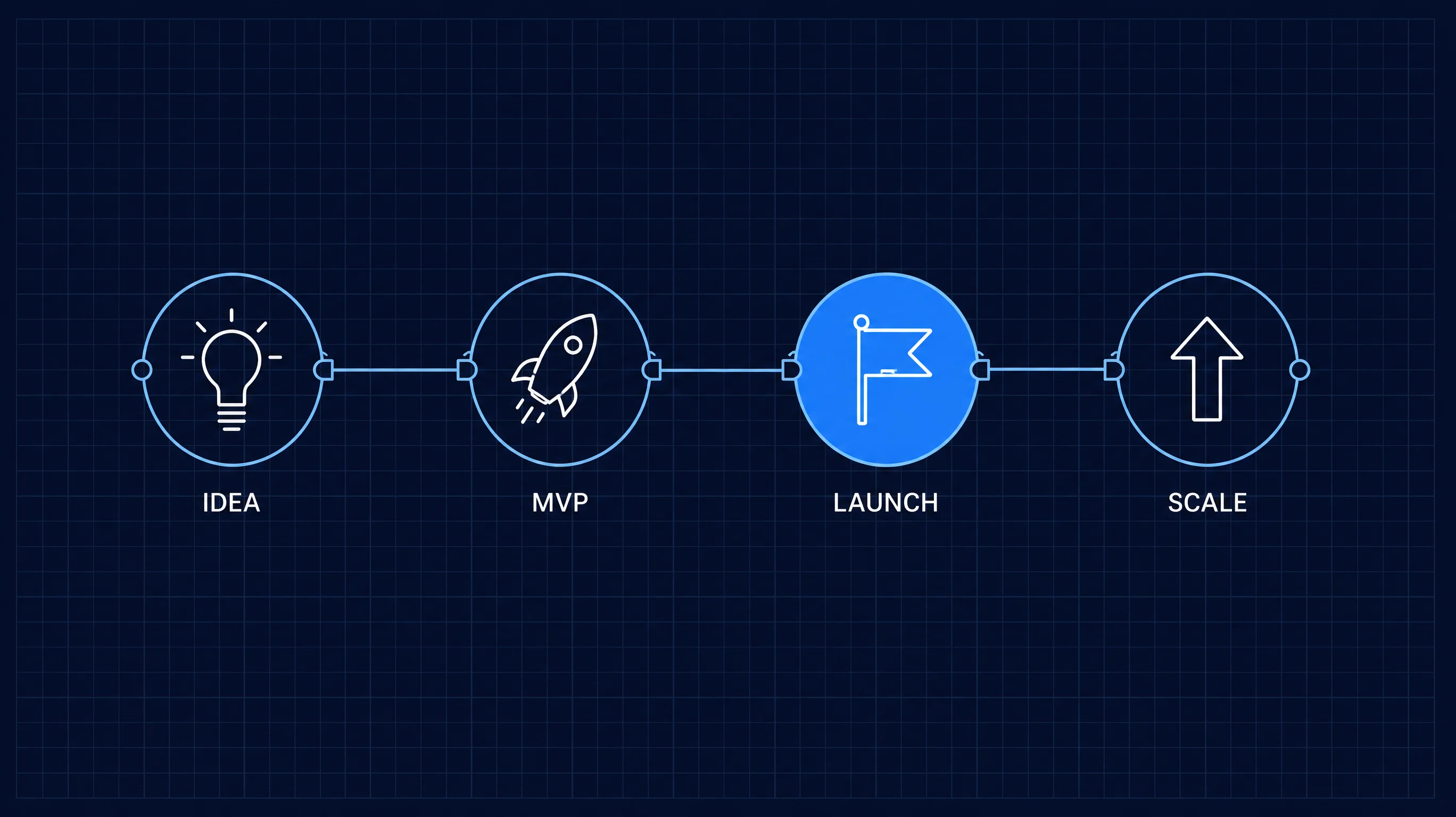
The difference with a startup isn't the phase, it's the starting point: a startup starts with the whole company, an existing SME starts with one department. We build that idea out further in the rest of this article.
In Anthropic's playbook, the founder's role shifts from doer to orchestrator: no longer doing everything yourself, but putting the right AI agents, tools and people in the right place.
Researchers at MIT Sloan Management Review see that same shift more broadly across business: valuable expertise is changing from "having the answers" to "asking the right questions and orchestrating AI tools" (MIT Sloan Management Review, 2025). For an SME director, this means oversight and judgment become more important than execution speed.
A director who keeps making every decision themselves becomes the bottleneck the moment AI speeds up the execution work. The question shifts from "how do I do this faster myself" to "who or what can pick this up, and who keeps an eye on it".
That's not a replacement for people. AI takes over the execution work, people stay responsible for the outcome. An employee who used to check invoices becomes the person who reviews the exceptions an AI system can't handle on its own.
Concretely, for an SME director this means: less time spent executing reports, quotes or planning, and more time deciding which processes get handed to AI and how the results get checked.
This shift in role doesn't happen in one conversation. Most directors keep watching the details closely for the first few months, and that's sensible: you build trust in a new process by checking it yourself first, not by letting go of it.
This is the core principle from the playbook that transfers most easily: start small, in one place, before you scale up. Researchers at Hanze name exactly this pattern in their handbook for AI implementation in SMEs: start small and manageable, instead of company-wide all at once (Hanze, Handboek AI voor het MKB).
Say an accounting firm with 40 employees notices that its financial administration carries the most manual work: retyping invoices, checking data, sending reminders. Instead of launching a company-wide AI project, the firm picks up just that one department. One workflow gets automated: incoming invoices get recognized, checked, and readied for approval. This is an illustrative scenario, not an existing case, but the pattern is recognizable for many SMEs with a similar department.
After a few months it's clear whether it works: less manual work, fewer errors, an employee who moves from data entry to review. Only then does the next department follow, carrying the lessons from the first round.
That the rest of the organization still works the old way is, at this stage, not a problem but an advantage: the other departments keep running undisturbed while there's one place learning what works and what doesn't.
Want to automate a specific process instead of overhauling an entire department? Our intelligent process automation starts exactly there: one process, with a clear result, before you scale further.
One department that proves it convinces faster than a company-wide plan on paper. That proof is also what you need to bring the rest of the organization on board.
A department working with AI needs three things: data in order, people on board, and one connected system instead of loose experiments.
AI adoption is growing among Dutch SMEs, but not everywhere at the same pace. Of companies with 10 to 50 employees, 27 percent used AI technology in 2025, against 45 percent of companies with 50 to 250 employees (CBS, December 2025). The bigger the company, the higher the adoption, but the smaller half of the SME market is still lagging.
Data in order doesn't mean a completely new system. It means the data an AI application needs is structured somewhere, not scattered across loose spreadsheets and emails.
People on board means the employees in the department understand why the process is changing and what their new role will be. Without that buy-in, an AI application stalls after the first month.
These three conditions apply to every department you tackle, not just the first. A common mistake is preparing the first department carefully and rushing the second and third, because management now assumes the pattern is known. Every department has its own data, its own people, and its own resistance.
A connected system means the departments you tackle one after another eventually talk to each other, instead of continuing to work in isolation. Our AI business brain was built for exactly that: one system where the separate experiments of different departments come together, instead of a collection of AI islands.
Want to know where you stand before picking a department? An AI strategy maps that out before you begin.
Not every AI initiative in the SME world reaches the finish line. Four patterns keep coming back.
The first pattern is the hype pilot: a tool bought because a competitor uses one too, without a concrete bottleneck underneath it. No problem means no measurable result, and no result means no follow-up.
The second pattern is shadow AI: employees using ChatGPT or similar tools themselves for sensitive business information, entirely out of management's sight. Research among Dutch employees shows that 78 percent of AI users do this without permission or oversight from IT (Awareways, 2026). That delivers individual time savings, but no organization-wide improvement, and it does carry risk.
The third pattern is the missing owner: an AI application that belongs to "everyone" belongs, in practice, to no one. Without someone responsible for the outcome, an initiative fades within a few months.
The fourth pattern is wanting everything at once. Starting five departments simultaneously spreads attention so thin that none of the five delivers the proof needed to continue.
Each of these four patterns can be spotted before it goes wrong, usually right at the start of an initiative. A tool with no named bottleneck, an employee with a quiet ChatGPT habit, a project with no name behind the ownership, or a plan with five parallel tracks: these are all signals visible in advance, not only in hindsight.
The common denominator behind these four patterns is a missing human checkpoint. Human-in-the-loop makes sure someone reviews the outcome of an AI process before it moves forward, so a mistake gets caught before it repeats. That checkpoint is exactly what the four patterns above are missing.
Not adding loose AI tools, but building processes and roles with AI as a fixed part. For an existing company, this mainly means: weaving AI into the process itself in one department, not placing a tool next to it.
No. The starting point for an existing SME is deliberately smaller than for a startup: one department or process, with a clear bottleneck and a clear owner. Only once that works does the next step follow.
In the department with the most repeatable manual work and the least risk if it goes wrong, think invoicing, data entry or planning. A small, measurable result convinces faster than a company-wide plan, and gives you the arguments you need for the next department.
AI-native means AI is part of how the company works from the design stage onward. AI-first is often used more loosely for companies that treat AI as a first consideration in new decisions, without it necessarily being woven into every process. For an existing SME, the result matters most: does the process work better with AI woven into it.
Not necessarily. Most SME applications run on existing AI platforms and automation tools, not custom-built models. What you do need: someone who owns the process and checks the outcome, and who gets time to do that alongside the rest of their work.
Measure at the department level, not the whole company: less time per task, fewer errors, or less repeated manual work. A proof of concept on one process delivers measurable numbers within a few months, instead of waiting a year for a company-wide result.
Start with one department, not the whole company. We help determine which department can deliver the first proof, and set that up together with your team.


.svg)