


Kronehoefstraat 85
5612 HL Eindhoven
BTW NL863902509B01
AI sales agents: the new B2B sales model for 2026
qw
vc
mshm
.svg)



An AI sales agent is not a chatbot and not a standalone tool. It is a software component with a defined role, its own access to systems like your CRM and LinkedIn, and the autonomy to execute tasks within predefined rules. Think of it as a digital colleague that runs 24/7, works consistently, and never forgets to send a follow-up.
The power isn't in a single agent, but in a system of specialized agents working together. A typical agentic sales stack contains seven roles: lead capture, qualification and scoring, outreach and asset generation, account health, conversation intelligence, CRM hygiene, and an orchestration layer that coordinates everything.
AI sales agents own the execution and the data; people remain owners of the relationships and the strategy.
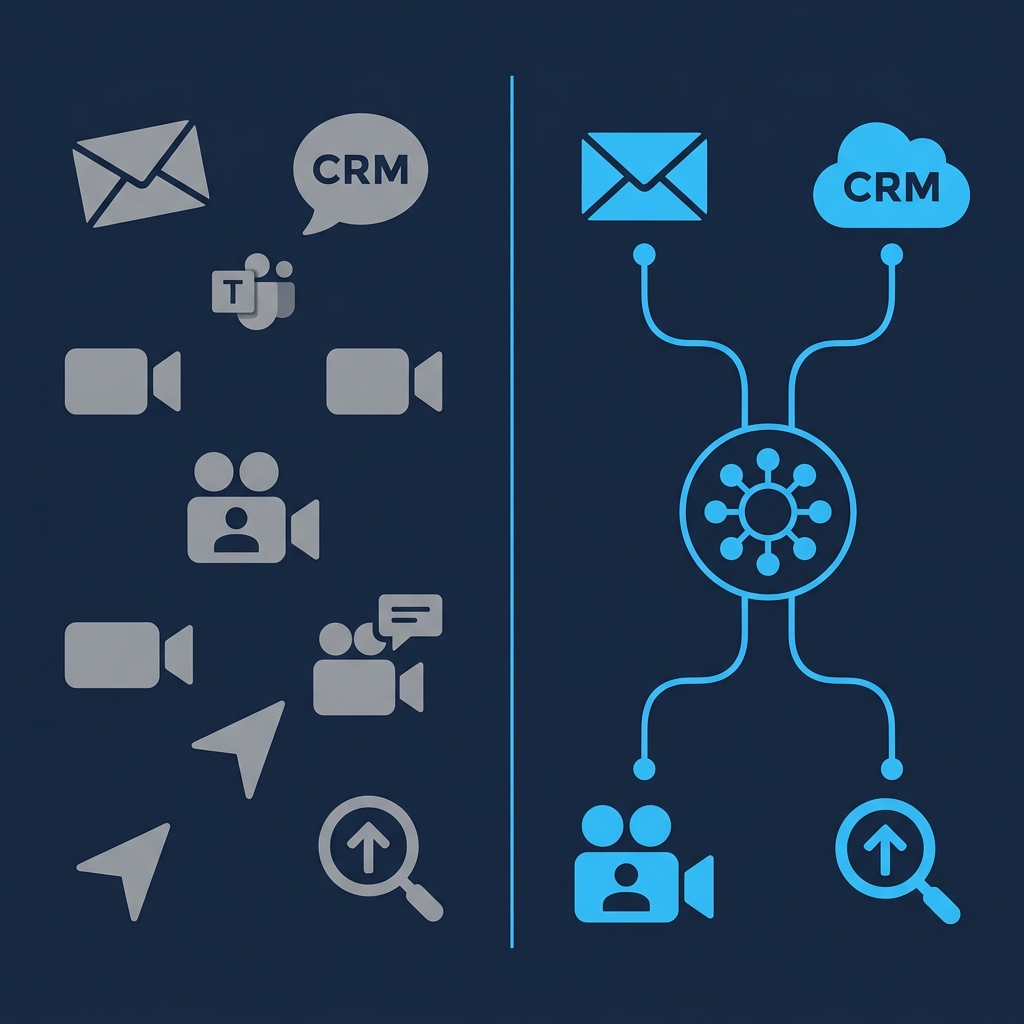
Over the past few years, many SMEs have stacked up standalone AI subscriptions: one tool for email, one for meetings, one for prospecting. On average that costs 200 to 500 euro per month without the tools talking to each other. An agentic system solves this by connecting agents through a central orchestration layer. The difference is comparable to a collection of standalone apps versus an integrated operating system.
Three shifts have fundamentally changed what works in B2B sales. Your buyers, your outreach channels, and your competitors are all moving to a new model. Anyone still running on the old one is losing ground.
89 percent of B2B buyers now use generative AI tools during the buying process. They compare vendors, build shortlists, and evaluate pricing before ever speaking to your team. A Gartner study shows that 61 percent actively prefer a fully rep-free buying experience.
That means the first point of contact is no longer your sales conversation. It's your content, your website, and your response speed to inbound signals. AI sales agents make that first-line response consistent and scalable.
Belkins analyzed 16.5 million cold emails and found that average reply rates dropped from 6.8 percent in 2023 to 5.8 percent in 2024 (Belkins Cold Email Report, 2025). By the fifth follow-up, response dropped 55 percent. Gartner confirms that 73 percent of B2B buyers actively avoid vendors that send irrelevant outreach.
More volume no longer works; only more relevance works.
Relevance at scale requires research, signal detection, and per-prospect personalization. That's exactly where AI sales agents beat manual approaches. Anyone who wants to translate this to their own channel will find an in-depth approach on our LinkedIn outreach services page.
75 percent of SMEs are experimenting with AI for sales, of which 34 percent have fully implemented it (Salesforce SMB Trends 2025). McKinsey reports that 88 percent of all organizations use AI in at least one business function (McKinsey State of AI 2025). In the Netherlands, 22.7 percent of companies used AI in 2024, an increase of nearly 9 percentage points compared to the year before.
The adoption gap between Europe and the US has closed at the user level (77 percent versus 78 percent), but American companies integrate AI in significantly more business processes. That's where Dutch SMEs can now close the gap.
Forget the technology for a moment. Here's how a workday changes in a sales team of 5 to 15 people.
08:00 The morning start. In the past, the sales manager opened the CRM, scrolled through incomplete records, and manually built a call list. Duration: 45 minutes, with half the information. Now every sales rep opens an overview built overnight with the top 12 priorities for the day, including website visits, funding announcements, and role changes. Time: 15 minutes scanning.
09:30 Prospecting. In the past, every prospect cost 15 to 30 minutes of research to write a personal first email. Result: at most 15 personalized messages per day. Now the system selects prospects matching the ideal customer profile, drafts a first message in the prospect's words, and presents it for review. Time per prospect: 2 to 3 minutes.
11:00 The sales call. Preparation drops from 30 minutes to 5. The briefing is ready: company overview, decision-makers, talking points, and expected objections. After the call, it takes 30 seconds before the summary lands in Slack, the CRM is updated, and the follow-up is queued.
16:00 Pipeline review. Used to be an hour, half of which went to checking data. Now 15 minutes of strategic discussion, because the data is already clean and risks are already flagged.
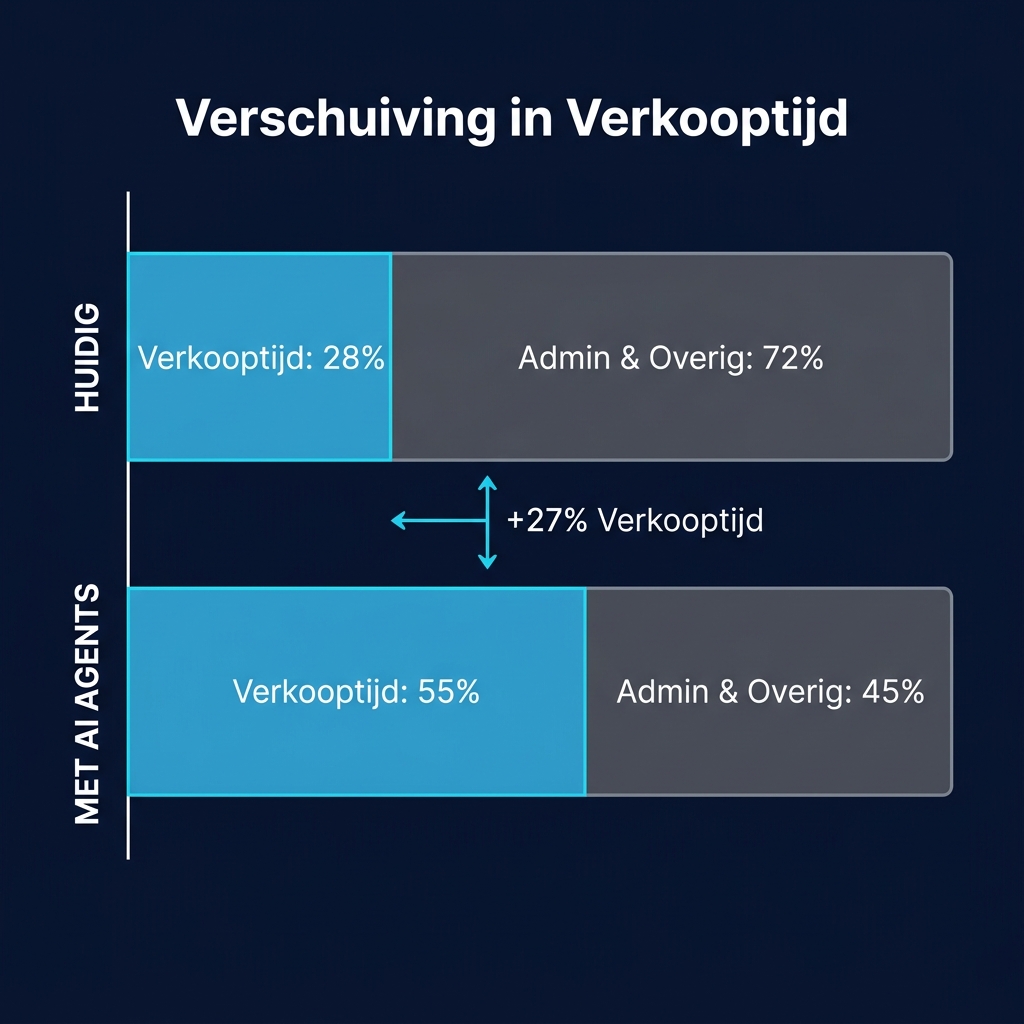
ActivityManualWith AI sales agentsMorning start45 minutes digging through CRM15 minutes scanningProspecting per lead15 to 30 minutes2 to 3 minutesUpdating CRM25 to 30 hours per monthAutomatic, real-timeFollow-upDepends on memoryFully automaticPipeline review1 hour cleaning data15 minutes strategySelling time28 percent of the work week55 percent or more
The 28 percent selling time figure comes from Salesforce State of Sales 2024. The rest of the week goes to admin, switching tools, and searching for data.
The business case for AI sales agents is not theoretical. Multiple large-scale datasets and public case studies back it up.
Revenue and conversion. McKinsey reports revenue increases of 3 to 15 percent at organizations investing in AI for sales (McKinsey, 2023). Bain documents more than 30 percent improvement in win rates among early adopters. Gong reports 29 percent higher sales growth at AI-using companies.
Productivity per sales rep. Microsoft measured 9.4 percent higher revenue per sales rep and 20 percent more closed deals in an internal study of 687 sales reps. Gartner shows that sales reps who collaborate effectively with AI are 3.7 times more likely to hit their quota.
Time savings on specific tasks. At Lumen Technologies, research time per account dropped from 4 hours to 15 minutes, with an estimated annual saving of 46 million euro. Agicap, a French FinTech company with more than 150 sales reps, saves 750 hours per week on call summaries, CRM updates, and email drafting, with a 20 percent increase in deal velocity (HubSpot Case Study: Agicap).
An agentic sales system typically costs 2,000 to 5,000 euro per month, depending on size and integrations. Compare that to the alternatives:
InvestmentMonthly costAgentic sales system2,000 to 5,000 euroHiring a sales consultant150 to 200 euro per hourHiring a VP of Sales8,000 to 12,000 euro plus recruitmentHiring an extra SDR7,000 to 11,000 euro fully loadedStandalone AI tools without integration200 to 500 euro
A 3,000 euro per month system that makes your team more effective delivers more than an extra hire at 8,000 euro per month who inherits the same inefficiencies.
76 percent of organizations achieve ROI from AI within 12 months (Salesforce, 2025). A 90-day pilot is enough to prove value. That's exactly the scope of our Agentic Growth Sprint.
Not everything at once. The transformation follows a phased approach where each phase delivers measurable value before the next one starts. This is the model we use in every SME engagement.
Audit your current sales stack, data quality, rep time spent, pipeline accuracy, and outreach effectiveness. Benchmark against the figures in this article. Identify the two to three problems with the highest leverage. Without this baseline, you won't be able to measure afterward what the system delivered.
Introduce AI assistants for the tasks that consume the most rep time: email drafting, call summaries, account research, and proposal generation. People stay fully in the loop. The goal is to build trust, measure productivity gains, and define what good looks like within your specific sales process.
Deploy autonomous agents for inbound lead capture, qualification, CRM automation, and outreach. Configure enrichment integrations, set up automated nurture tracks, and define the rules for when agents act versus escalate to humans. This is where the biggest time savings become visible.
Add conversation intelligence, AI forecasting, and account health monitoring. Train the team on the full system. Measure outcome metrics (win rate, deal velocity, revenue per interaction) and set up a feedback loop so every interaction makes the system better.
The first results are visible within 4 to 6 weeks; full setup is in place within 3 to 4 months.
For the strategic setup of this engagement we often work from our AI strategy and roadmap service, so choices are tied to concrete business outcomes instead of standalone tools.
The EU AI Act has been in force since August 2024, with phased implementation through August 2026. By that date, high-risk AI systems must be fully compliant (European Commission, AI Act). Most common AI sales tools fall under minimal risk, but transparency requirements apply to all AI applications.
What this means in practice for sales:
77 percent of Dutch companies don't yet fully understand their AI Act obligations. Setting this up correctly from the start is both a legal necessity and a competitive advantage over companies that have to repair things later. Our EU-compliant AI Stack service is specifically designed for this.
Roles don't disappear. They shift to higher-value work.
SDRs become system operators and outbound specialists. Instead of manually chasing every inbound form, they supervise AI agents that handle first-line qualification. They only step in for complex situations or high-value accounts.
Account executives get their time back. Proposals, briefings, and follow-up emails are pre-built. CRM data updates itself. The share of actual selling time rises from 28 percent to 55 percent or more.
Sales operations becomes the architecture team. Instead of pulling reports and cleaning data, sales ops designs the system: defining ICP rules, tuning scoring models, configuring agent behavior, and analyzing what works.
A new role emerges: the Go-To-Market Engineer. Job openings for this role grew more than 200 percent year-over-year in 2025, with median compensation of 118,000 euro. At Vercel, a GTM Engineer replaced a ten-person SDR team within six weeks without conversion dropping.
A warning: Klarna doubled revenue while headcount shrank from 5,500 to 3,000, but publicly admitted they had gone too far and started hiring again. Lesson: AI should strengthen your team, not hollow it out. The companies with the best results redeploy people to higher-value work.
If three or more of the following points describe your current operation, the gap between where you are and where the market is moving is widening:
Every month of delay is a month in which your competitors build the systems that will define the next era of B2B sales.
A chatbot responds to questions within a fixed script. An AI sales agent autonomously executes tasks across multiple systems (CRM, email, LinkedIn, calendar) and makes decisions within predefined rules. Think of the difference between an answering machine and a junior colleague.
No, they take over the 70 percent of administrative work so sales reps have more time for relationships and complex deals. Companies that tried to fully replace people (like Klarna) have walked it back. The model that works: AI for execution, people for judgment and relationships.
A working system typically costs 2,000 to 5,000 euro per month, including integrations and tuning. Compare that to 7,000 to 11,000 euro for an extra SDR, or 8,000 to 12,000 euro for a VP of Sales. ROI typically lands within 6 to 12 months.
Rarely. Most SME CRMs have duplicate records, empty fields, and outdated contact data. One of the first agents we deploy is a CRM hygiene agent that cleans this up in 2 to 4 weeks and then keeps it clean. Don't wait until your data is perfect before you start; make data cleanup part of the implementation.
AI sales agents typically fall under minimal risk in the AI Act, but transparency and audit requirements still apply. Important: AI-generated messages must be traceable, there must be a human-in-the-loop for impactful decisions, and personal data remains under GDPR. We build systems EU-compliant from the start, with European data centers and audit trails.
Yes, and that's the approach we recommend. A 90-day pilot on 2 to 3 processes shows measurable results before you invest further. This is the setup of our Agentic Growth Sprint: concrete wins in 90 days on the processes with the highest leverage.
That's the normal starting point for Dutch SMEs of 10 to 100 employees. You don't need an in-house team; you need a partner who builds, configures, and keeps tuning the system. Our Fractional Chief AI Officer service is specifically for this situation: CTO-level leadership without hiring someone full-time.
AI sales agents are no longer hype. They are the operational reality your biggest competitors are already working with or starting on this year. The question is not whether you'll do this, but at what pace and in what order.
The biggest gains rarely sit where you look for them; that's why every engagement starts with a diagnosis, not a tool choice.
In 30 minutes we'll map where the biggest gains are in your sales operation. No sales pitch, no generic demo, but a concrete baseline with the three processes where AI sales agents will make the difference for your company.
Book a call with Vincent de Vos
Prefer to take a look yourself first? Take the Sales Operations Readiness Assessment or download the full Agentic Sales Playbook 2026.
Last updated: 2026-04-24. Sources: Forrester, Gartner, Salesforce, McKinsey, Bain, Microsoft, Gong, CBS, Eurostat, European Investment Bank, European Commission. Full reference list in the Agentic Sales Playbook 2026.


.svg)