




Kronehoefstraat 85
5612 HL Eindhoven
BTW NL863902509B01
Agentic Automation vs Traditional IT Automation: What Fits Your Business?
qw
vc
mshm
.svg)




Last updated: 2026-06-17
Traditional IT automation follows exact instructions: every step, every exception has to be scripted in advance. Agentic AI works differently: an agent observes the situation, reasons about the goal, and chooses the right action itself, even when the situation is not exactly as expected. The difference is not about speed, but about the capacity to deal with change.
Traditional IT automation works on the basis of rules. You describe precisely what has to happen: when step A is done, run step B. If condition X applies, do Y.
The best-known forms are scripts (Python, PowerShell), Robotic Process Automation (RPA) and workflow tools such as Zapier or Make. They are quick to implement for tasks that always run the same way.
Think of automatically archiving invoices once they are approved, or sending a confirmation email after a form submission. As long as the structure stays stable, this works well.
The problem starts the moment something changes. A supplier adjusts its invoice format. A screen update shifts a button. A customer sends an attachment that does not fit the expected structure.
At that point the automation stops, or worse: it breaks without anyone noticing. Employees step in manually, and the "automation" costs more maintenance time than it saves.
Three patterns we keep running into at SMEs:
According to Camunda, many automation projects fail precisely because the orchestration layer is missing: there is no intelligence that decides what should happen when the happy path is not followed.
An AI agent does not work with a script. It works with a goal.
You give the agent an assignment: "Process incoming quote requests and prepare them for our account managers." The agent decides for itself which steps are needed, requests missing information, processes the attachments regardless of their format, and files the result in the right system.
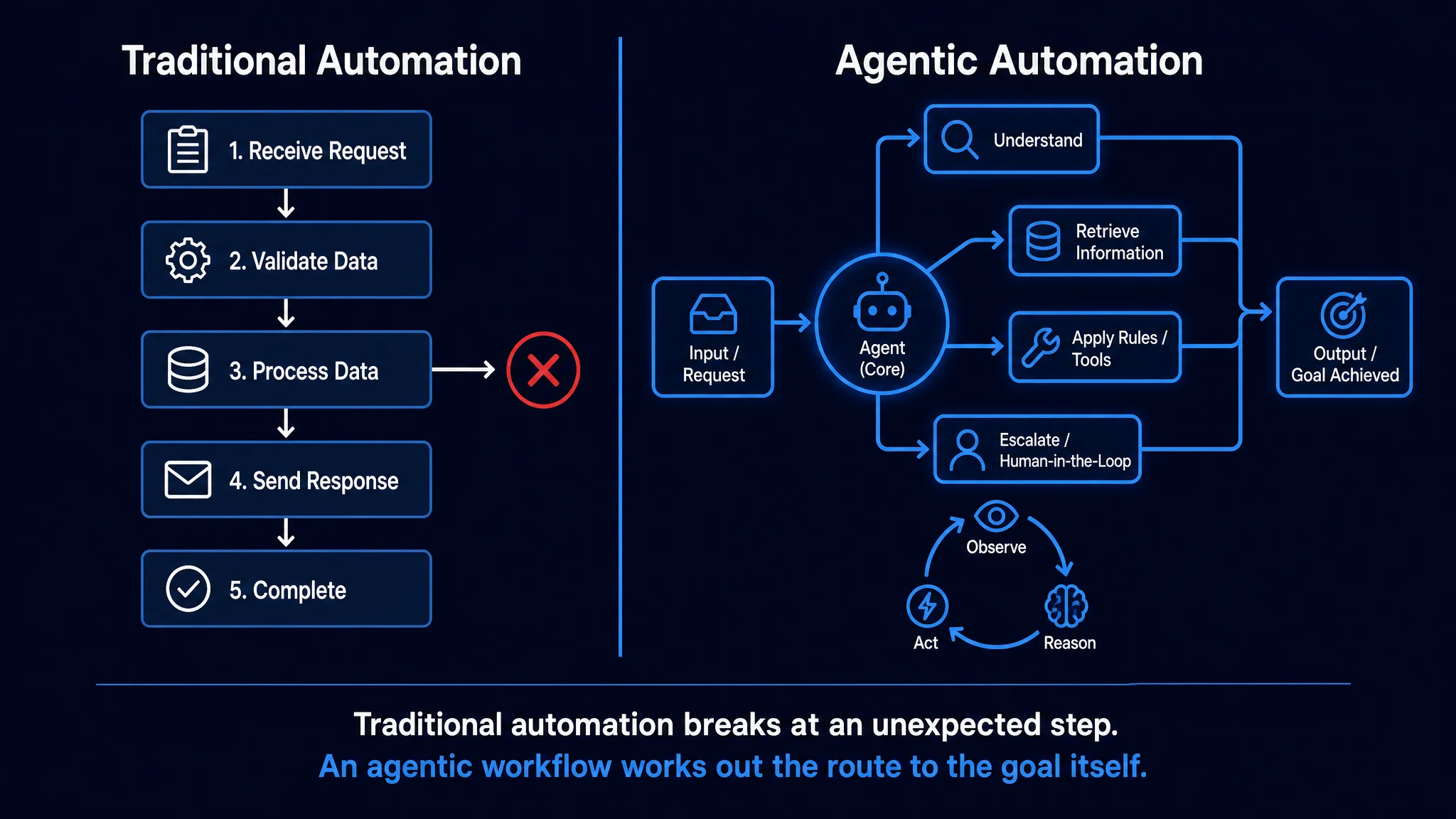
Intelligent Automation combines rules and AI, but agentic automation goes further: the agent learns from context and adapts its approach without you having to rewrite the instructions.
Three characteristics that set an AI agent apart from traditional automation:
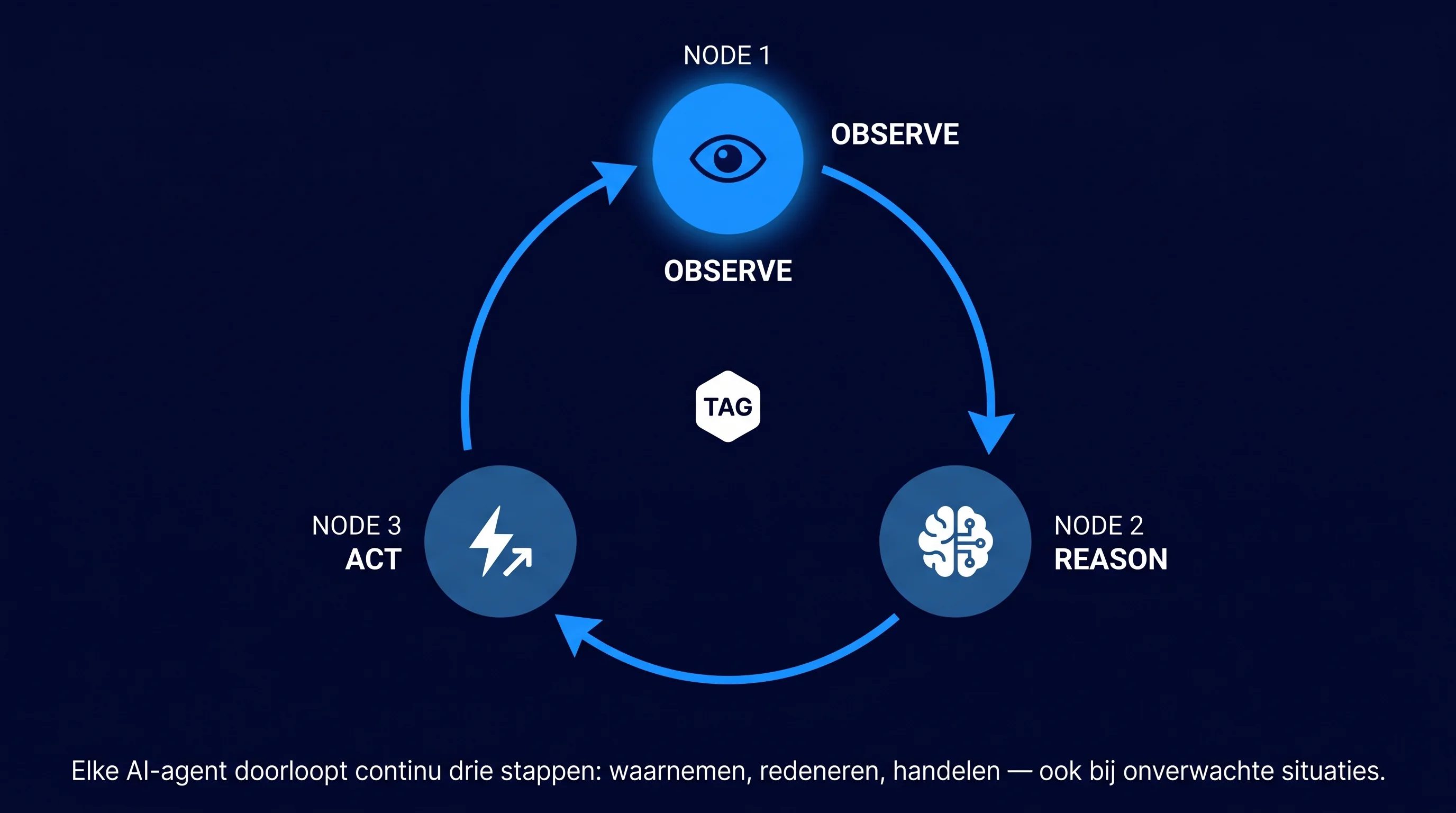
This is the observe-reason-act cycle that every AI agent runs through, also described in the UiPath agentic automation overview.
The difference is not technical. It is conceptual.
Traditional automation asks: how do I carry this out exactly? Agentic automation asks: what needs to be achieved here?
Suppose you deploy an agent to process incoming purchase orders. A traditional RPA bot reads row by row from a fixed CSV. An AI agent can also process an email with an attachment, email the supplier back when fields are missing, and decide for itself when human approval is needed via human-in-the-loop.
That last hypothetical example is not exceptional. It is exactly the kind of process where agentic automation proves its added value.
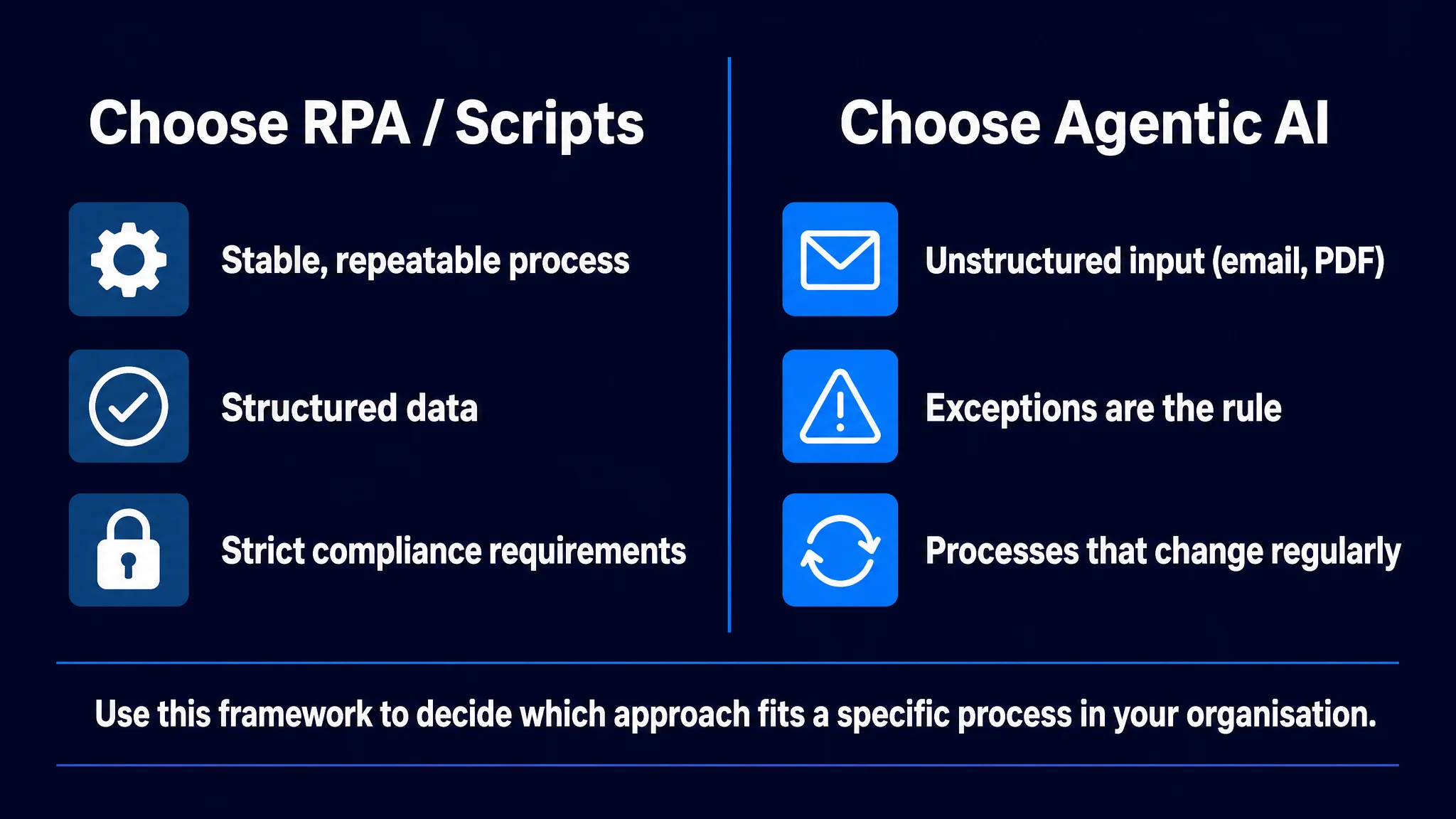
Both approaches have their place. The question is which one fits your specific situation.
Eurostat data (2025) shows that 19.95% of EU companies with 10+ employees already use AI. In the Netherlands that figure was 22.7% in 2024, above the EU average (CBS AI Monitor 2024). Most applications, however, are still document-based: text mining and natural language generation dominate, not agentic workflows.
The next step, from document processing to agentic process automation, is exactly where most SMEs stand today.
To make it concrete: a hypothetical scenario, clearly labelled as such.
Suppose an accounting firm receives dozens of quote requests by email every day. Customers send these in various formats: one as a Word document, another as a PDF, some type their question straight into the email.
A traditional automation stops right here: the input is too variable.
An agentic workflow works as follows:
This scenario does not just save time: it also reduces errors because information is never retyped by hand again, and it ensures a consistent customer process no matter who is on duty that day.
More on how such a connected system works: see how the AI Business Brain fuses multiple agents into one working whole.
The question is not whether agentic automation is better than traditional automation. The question is: which processes in your business are ready for which approach?
A practical approach in three steps:
Want to know which approach fits your specific situation? An AI Strategy & Roadmap helps you map this out before you invest in implementation.
Implement Consulting Group estimates that generative AI and agentic applications together could deliver EUR 65-70 billion in economic value for the Netherlands (Implement Consulting Group, 2024). Much of that potential sits in processes that SMEs still handle manually or with fragile automation today.
RPA (Robotic Process Automation) carries out fixed instructions step by step. It works well for stable, repeatable processes with structured data. Agentic automation uses AI agents that reason about a goal and make decisions on their own. They understand unstructured input, deal with exceptions, and adapt their approach without you having to rewrite the rules.
Yes. Agentic automation is no longer enterprise-only technology. The tools have become more accessible, and the implementation threshold has dropped. Smaller businesses (25-100 employees) benefit precisely because they have the processes that require intelligence, but not the capacity to handle every exception by hand.
No. Traditional automation and agentic automation can coexist. You keep stable processes on RPA or scripts. You deploy agentic agents where the input is variable or where decision-making is required. A hybrid approach is often the most practical.
A first agentic workflow is operational within two to four weeks, depending on the complexity of the process and the integrations needed. Most SMEs start with a pilot on one process: that delivers a concrete result and a clear foundation for the next step.
The initial investment is higher than a simple script or a basic Zapier flow. But the total cost of ownership is often lower: traditional automation requires constant maintenance as soon as processes change. Agentic agents do this themselves. The ROI is in fewer hours of manual repair work, not in lower licence costs.
Processes with unstructured input (emails, PDFs, free text), processes with shifting contexts (customer questions, exception cases), and processes that regularly require escalations. Examples: incoming quote handling, purchase order processing, complaint handling, candidate processing in recruitment.
Security depends on the architectural choices, not on the technology itself. A well-designed agentic workflow works with EU-based models and data stores, strict access controls, and audit logs for every decision. More on the compliance aspects: see our approach to an EU-compliant AI stack.
An AI agent is a software component that autonomously carries out a task by repeating three steps: observe (gather information), reason (reason about the best action), and act (carry out the action through tools or APIs). In practice this means the agent works like a digital employee: it receives an assignment, decides on the approach itself, and reports the result.
The shift from traditional automation to agentic AI does not have to be big. We help you determine where the biggest time savings are and how to realise that step by step.


.svg)