


Kronehoefstraat 85
5612 HL Eindhoven
BTW NL863902509B01
AI sales assistant: how AI strengthens your SDR without replacing them
qw
vc
mshm
.svg)



An AI sales assistant strengthens your SDR by taking over the time-consuming, data-heavy tasks: prospect research, first-draft emails, follow-up sequences, CRM updates, and lead prioritization. The SDR stays in control of relationships and final judgment calls. The result is more selling time, better-prepared conversations, and higher conversion rates, without replacing the human who closes the deal.
Most sales development representatives (SDRs) spend the majority of their workday on tasks that are not sales. Research from Salesforce's 2024 State of Sales report found that sales reps spend only 28% of their working week on actual selling. The remaining 72% goes to prospecting research, writing outreach emails, updating the CRM, scheduling follow-ups, and administrative reporting.
This is not a motivation problem. It is a capacity problem. An SDR who spends 4 hours preparing personalized emails for 20 prospects does not have 4 hours left for discovery calls. The bottleneck is not talent, it is the sheer volume of repetitive preparation work that surrounds every qualified conversation.
AI does not change what a good SDR does. It changes how much time that SDR has to do it. According to Amplemarket's 2025 analysis, users of an AI sales co-pilot saved an average of 10 hours per week on manual tasks. Across a 50-week year, that is 500 hours per SDR returned to selling.
In 2024 and early 2025, a wave of companies marketed fully autonomous AI SDRs: tools that would prospect, email, qualify, and book meetings without any human involvement. Several large B2B teams deployed them. By early 2026, the results were in.
According to Amplemarket's review, companies that deployed fully autonomous AI SDRs at scale, including teams using 11x.ai and similar tools, largely reverted to hybrid models or returned to human-first approaches. The reason: fully autonomous outreach produces volume, but it struggles with the nuance required for complex B2B deals where trust, context, and relationship history matter.
DataStax is a concrete example. After switching from a fully autonomous AI SDR to a co-pilot model, the team closed 7 enterprise deals in 5 months. The change was not the technology. It was the model: AI preparing, human deciding.
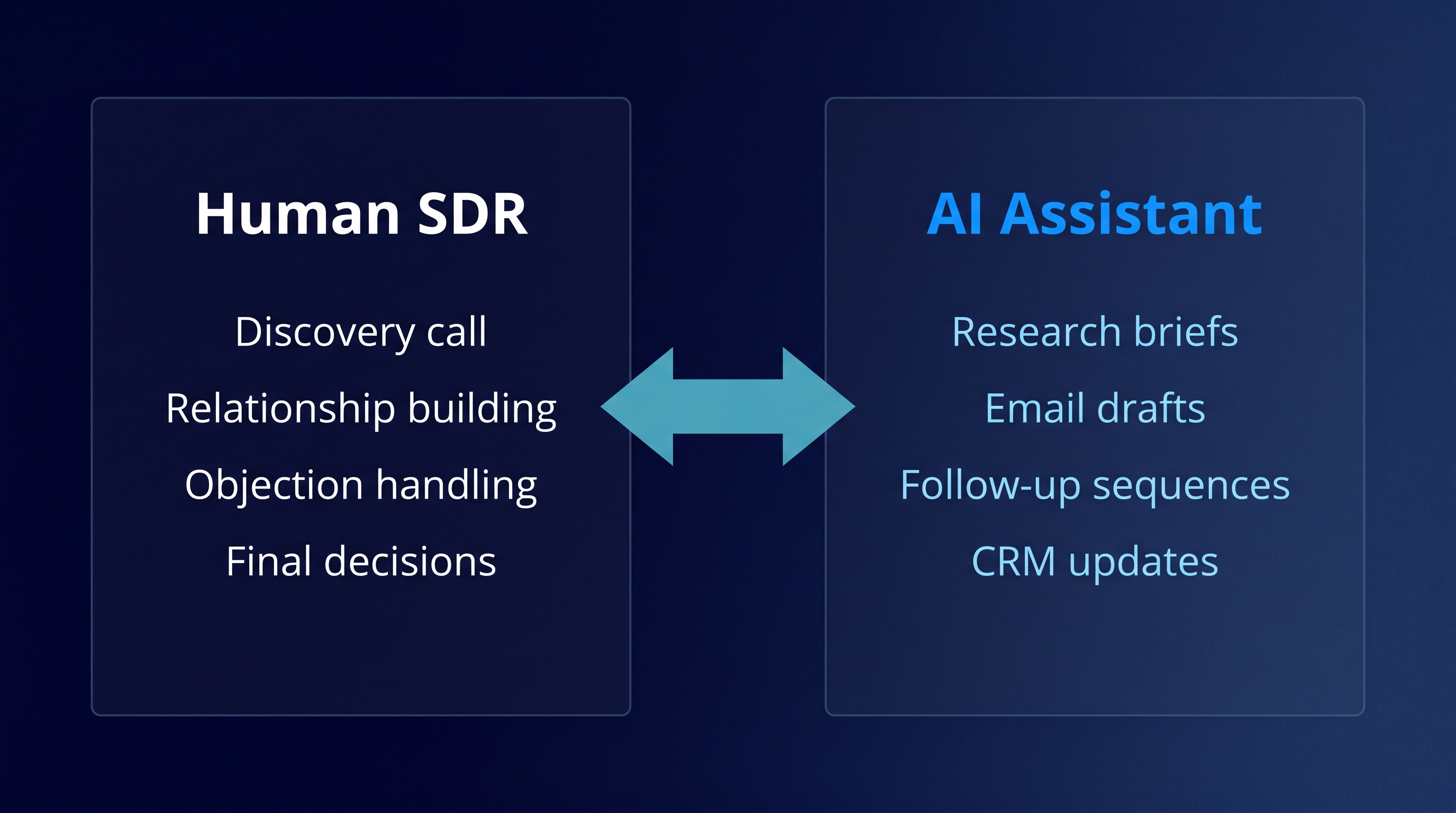
The co-pilot model works because AI and humans are good at different things. AI excels at processing large amounts of data quickly, generating consistent first drafts, and never forgetting a follow-up. Humans excel at reading between the lines, adjusting tone to a specific buyer, and building the trust that moves a deal forward.
The practical division of labor:
Prospect Research
Drafting Emails
Follow-up Sequences
CRM Hygiene
Lead Prioritization
Discovery Call
Relationship Building
Handling Objections
To make this concrete: here is how a typical workday looks for an SDR using an AI sales assistant as a co-pilot.
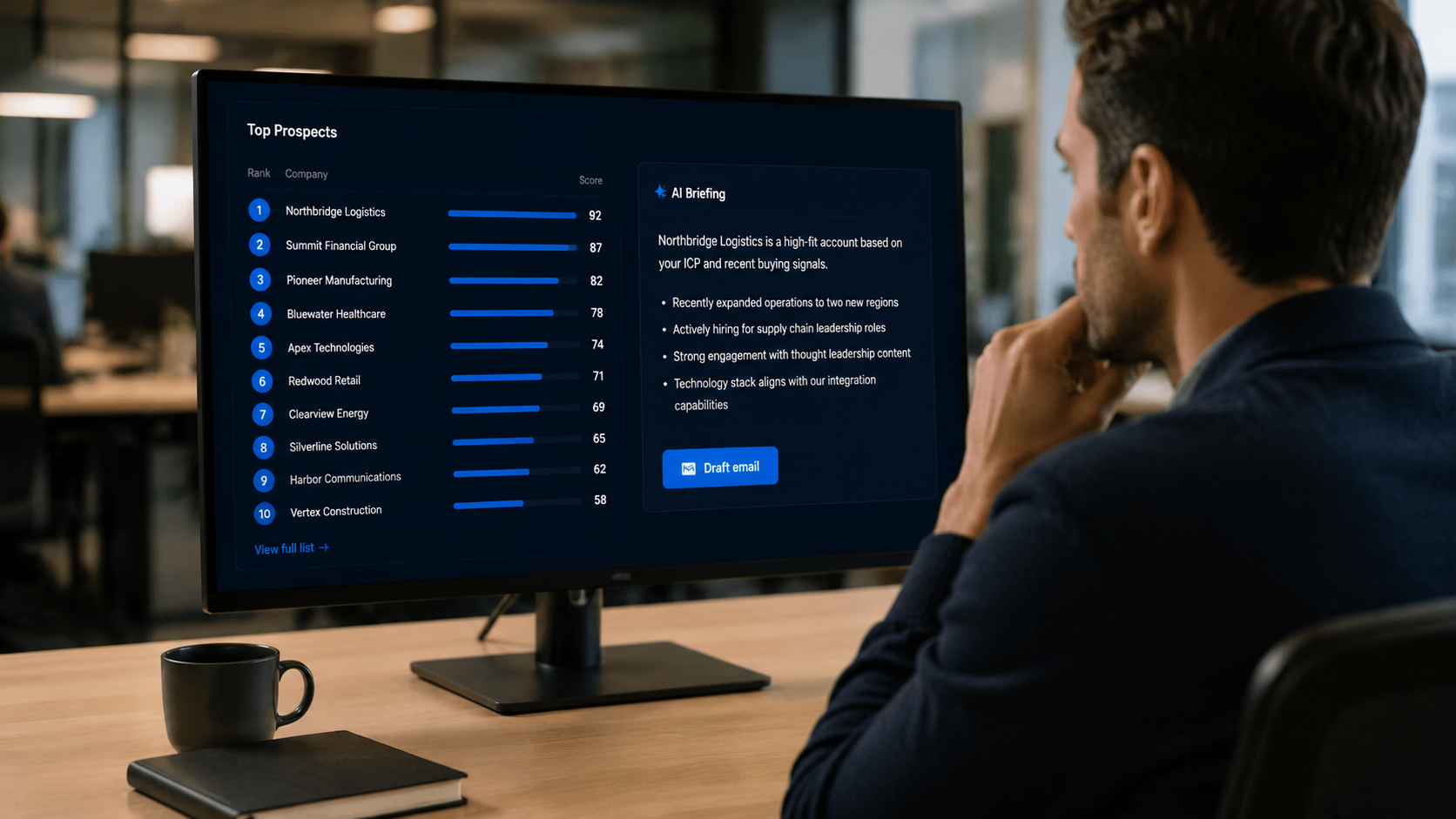
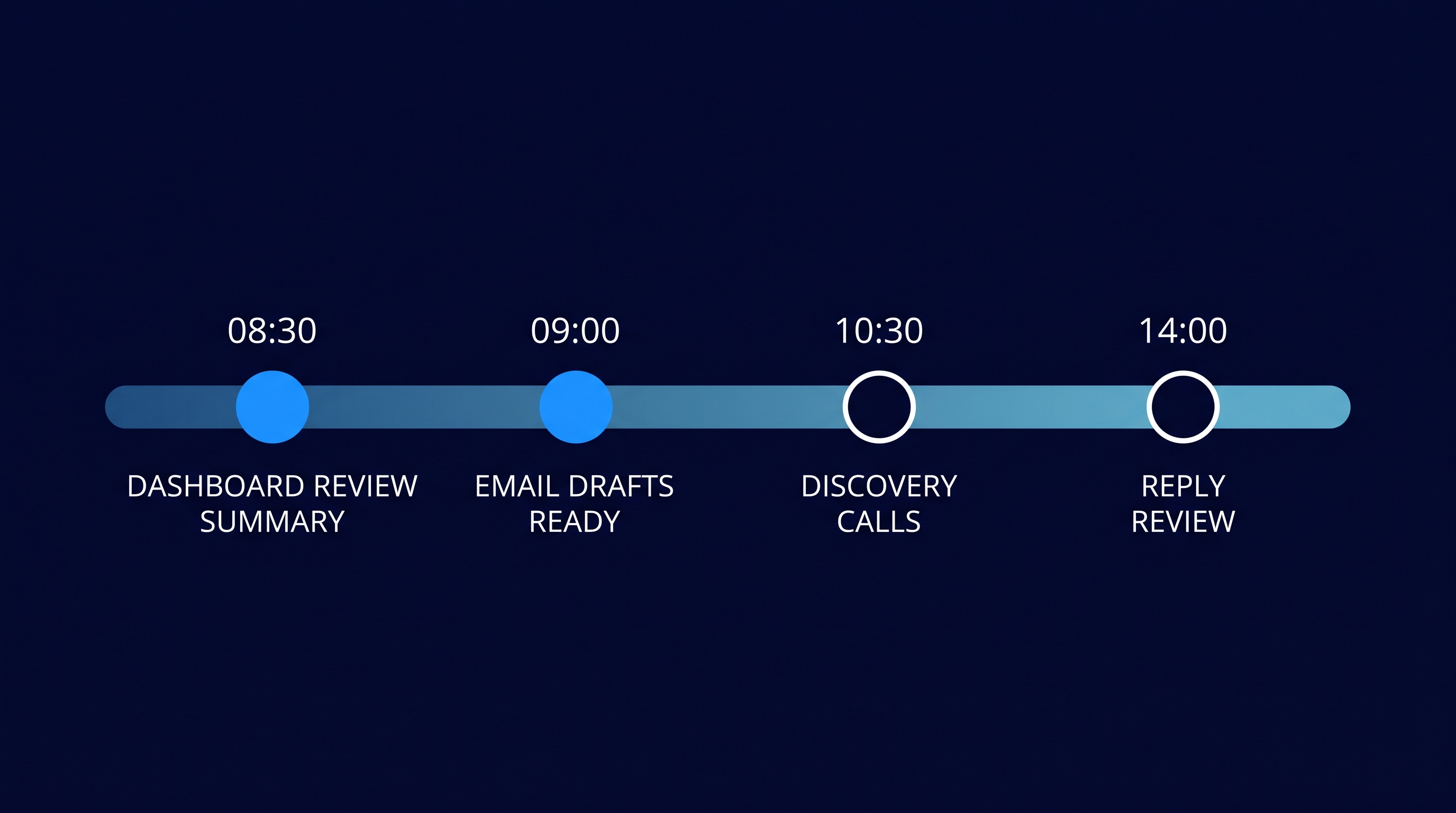
08:30 The SDR opens their dashboard. The AI has already ranked their prospect list based on overnight buying signals: one target company visited the pricing page twice, another published a job post for a new operations director. These accounts are flagged at the top.
09:00 For each priority account, the AI has generated a one-page research brief: company size, recent news, tech stack, LinkedIn activity of the key contact, and a draft opening email with a specific hook based on that research. The SDR reads the brief in 4 minutes instead of 30, edits the email tone slightly, and hits send.
10:30 After two discovery calls, the SDR sees that the AI has already updated the CRM with call notes, flagged next steps, and queued follow-up emails for review. What used to take 45 minutes of post-call admin takes 8 minutes of review and approval.
14:00 The AI flags three leads that have gone cold for more than 12 days and suggests a re-engagement message with a new angle based on a recent industry report. The SDR picks two of the three, adjusts the message for one of them, and approves the other as-is.
End of day: The SDR had 5 live conversations instead of the usual 2 or 3. They spent zero time on manual CRM updates and roughly 25 minutes on email drafting instead of 2 hours. The AI handled the preparation; the SDR handled the people.
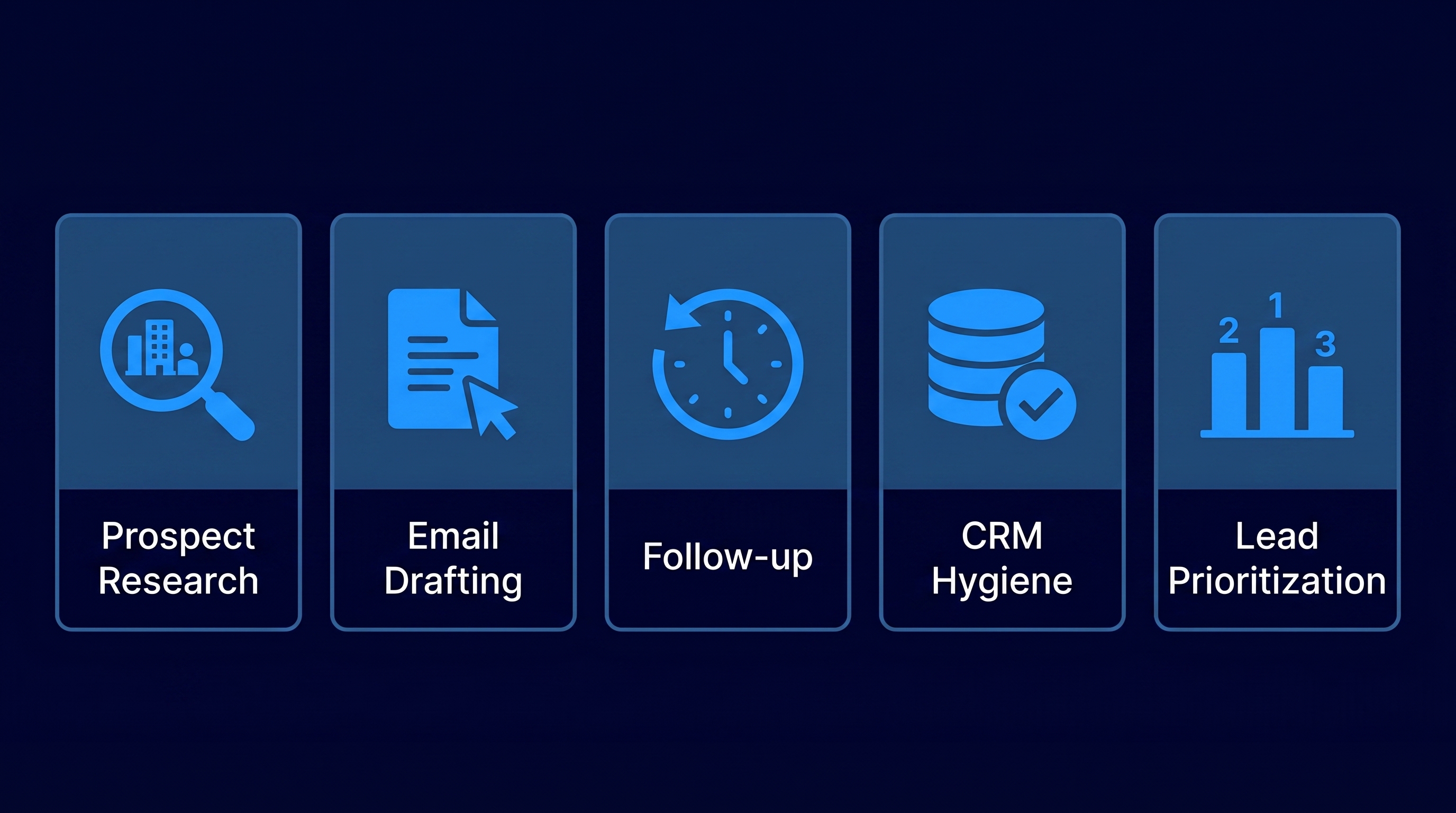
The five highest-impact use cases where an AI sales assistant adds measurable value for an SDR team are outlined below.
An AI assistant aggregates data from LinkedIn, company news feeds, intent data providers, and CRM history to produce a structured research brief for each prospect. What previously took 20 to 40 minutes per account takes 2 to 5 minutes of review. Salesforce's 2024 data shows sellers expect AI to cut prospect research time by 34%.
AI generates a personalized first draft based on the prospect's profile, the company's situation, and prior conversation history. The SDR reviews and edits rather than writing from scratch. According to HubSpot's 2025 State of Sales report, 83% of sales professionals say AI helps them personalize prospect interactions more effectively. Signal-personalized outreach achieves 15 to 25% reply rates, compared to the 3 to 5% average for generic cold email.
80% of deals close after 5 or more touchpoints, yet most SDRs stop after 2 (HubSpot, 2025). AI executes timed follow-up sequences automatically, adjusting send time to each contact's engagement patterns. Replies that require judgment are routed back to the SDR. Replies that are simple confirmations or scheduling requests can be handled directly. This eliminates the single biggest source of lost pipeline: deals that went cold because no one followed up.
Poor CRM data costs sales teams more than they realize: missed follow-ups, duplicate outreach, and inaccurate pipeline forecasting. An AI assistant auto-logs call summaries, updates deal stages, enriches company fields, and removes duplicates without manual effort. Salesforce estimates that AI-assisted CRM hygiene reduces data entry time by up to 36% per rep.
Not all leads deserve the same time. An AI assistant scores accounts based on firmographic fit, behavioral signals (website visits, content downloads, email opens), and intent data from third-party sources. The SDR wakes up every morning with a ranked list rather than a flat spreadsheet. Teams using AI-driven lead prioritization are 3.7x more likely to meet quota than teams working from unscored lists.
For a broader overview of how agentic AI systems support the full sales cycle, see our pillar page on agentic AI for B2B sales.
The performance data on AI-assisted sales teams is consistent across multiple large-scale studies conducted in 2024 and 2025:
These numbers represent averages across different team sizes and industries. The starting point for a Dutch SME with 3 to 10 SDRs will not be the same as a 200-person enterprise sales team. A realistic first target for a team new to AI-assisted selling: reclaim 5 to 8 hours per SDR per week on administrative tasks within the first 60 days of a structured implementation.
The compounding effect matters more than the launch-day number. Every hour reclaimed from admin is an hour that goes into pipeline activity. Over a quarter, that compounds into significantly more qualified conversations, follow-ups completed, and deals advanced.
Implementing an AI sales agent setup does require a clear starting point: which tasks are currently the biggest time drain for your SDRs, which tools are already in use, and which integrations need to be built. A 90-day pilot focused on two or three of the five use cases above is a practical approach for most MKB companies.
No. An AI sales assistant is a co-pilot that handles data-heavy and repetitive tasks: prospect research, first-draft emails, follow-up sequences, CRM updates, and lead prioritization. The SDR retains full ownership of relationships, discovery conversations, and final decisions. Companies that deployed fully autonomous AI SDRs in 2024 and 2025 largely reverted to hybrid models when complex B2B deals required human judgment.
The five most proven use cases are: aggregating prospect research into a structured brief, generating personalized first-draft outreach emails, executing timed follow-up sequences, updating and cleaning CRM records automatically, and scoring and ranking leads by buying signals and firmographic fit. Each of these reduces manual work for the SDR without removing human oversight from the final output.
According to Amplemarket's 2025 data, co-pilot users saved an average of 10 hours per week on manual tasks. Salesforce's 2024 State of Sales report found that sellers expect AI to cut prospect research time by 34% and email drafting time by 36%. For a team of 5 SDRs, 10 hours per week per person equals 50 hours of selling capacity per week added without hiring anyone.
Tools that commonly operate in co-pilot mode include Outreach (AI-assisted sequences and replies), Salesloft (AI summaries and call coaching), Apollo (AI prospecting and enrichment), Clay (prospect research automation), Gong (call intelligence and deal insights), and Lavender (AI email drafting). The right choice depends on which part of your SDR workflow loses the most time today.
Yes. For a Dutch SME with 2 to 10 SDRs, the co-pilot model is often more practical than a fully autonomous AI SDR setup. The implementation complexity is lower, the cost per seat is manageable, and the impact on each individual rep's capacity is immediately visible. A 90-day pilot targeting two or three specific tasks is a realistic starting point.
Not necessarily. Most AI sales assistant tools integrate with common CRM systems (HubSpot, Salesforce, Pipedrive) and email clients via standard connectors. A basic co-pilot setup for prospect research, email drafting, and CRM sync can often be operational within two to four weeks. More advanced setups involving custom scoring models or multi-system orchestration take longer and benefit from expert guidance.
An AI SDR is designed to operate autonomously: it prospects, emails, qualifies, and books meetings with minimal human involvement. An AI sales assistant (or co-pilot) is designed to amplify a human SDR: it prepares information, generates drafts, and executes follow-ups, but the human reviews and approves. For complex B2B sales in the Dutch market, the co-pilot model consistently delivers better results because relationship nuance and buyer trust require human judgment.
The Agentic Group implements AI sales assistants that strengthen your SDR without replacing them. We start with the tasks that cost your team the most time and build from there.


.svg)